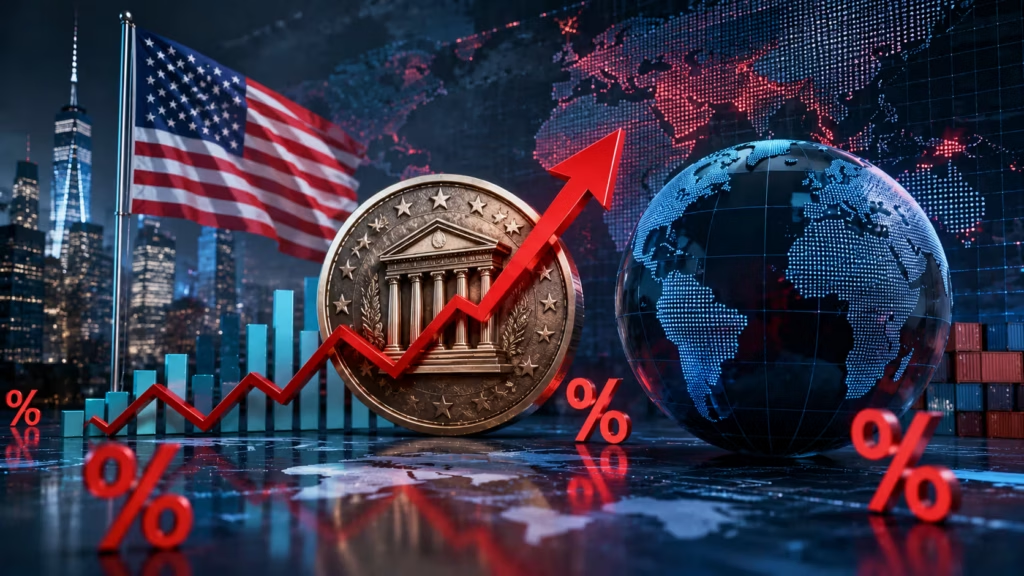
Why global markets are reacting to rising US interest rates is one of the biggest financial stories of 2026. In late April, the Federal Reserve held its benchmark interest rate steady at 3.50%–3.75% for the third meeting in a row, and markets around the world felt the impact immediately. Treasury yields moved, currencies shifted, and stock markets from Tokyo to São Paulo responded. To understand why decisions made in Washington, D.C. reach every corner of the globe, you first need to understand how the US interest rate system works — and why it is so much more powerful than those of any other country.
Why Global Markets Are Reacting to Rising US Interest Rates
The United States dollar is the world’s reserve currency. That single fact makes the Fed’s decisions more powerful than any other central bank on earth. When the Fed raises rates — or keeps them elevated — money flows toward the US from everywhere else, because investors can earn higher returns on dollar-denominated assets. That global capital shift sets off a chain reaction that affects bonds, currencies, stock markets, and government finances in countries that had no say in the decision at all.
Right now, the Fed is not actively raising rates. But it is holding them at a historically elevated level while the rest of the world had expected cuts. That sustained “higher for longer” stance is producing the same effect as a rate increase: global capital is moving toward the safety of US assets, and the rest of the world is adjusting in real time.
The Current State of US Interest Rates in 2026
The Federal Reserve held the federal funds rate at 3.50%–3.75% at its April 28–29, 2026 meeting. This was the third consecutive meeting without a change, and markets are pricing in no changes for the rest of 2026 and well into 2027.
The Fed began cutting rates in late 2024, reducing the target by 1.75 percentage points across 2024 and 2025. But the Iran conflict — which began on February 28, 2026 — pushed oil prices up nearly 80% from the start of the year. That energy shock has pushed inflation back up toward 3%, well above the Fed’s 2% target, and halted the easing cycle in its tracks.
JPMorgan now expects the Fed to hold steady through all of 2026. Its analysts see the next move as a potential rate hike of 25 basis points in the third quarter of 2027 — not a cut.
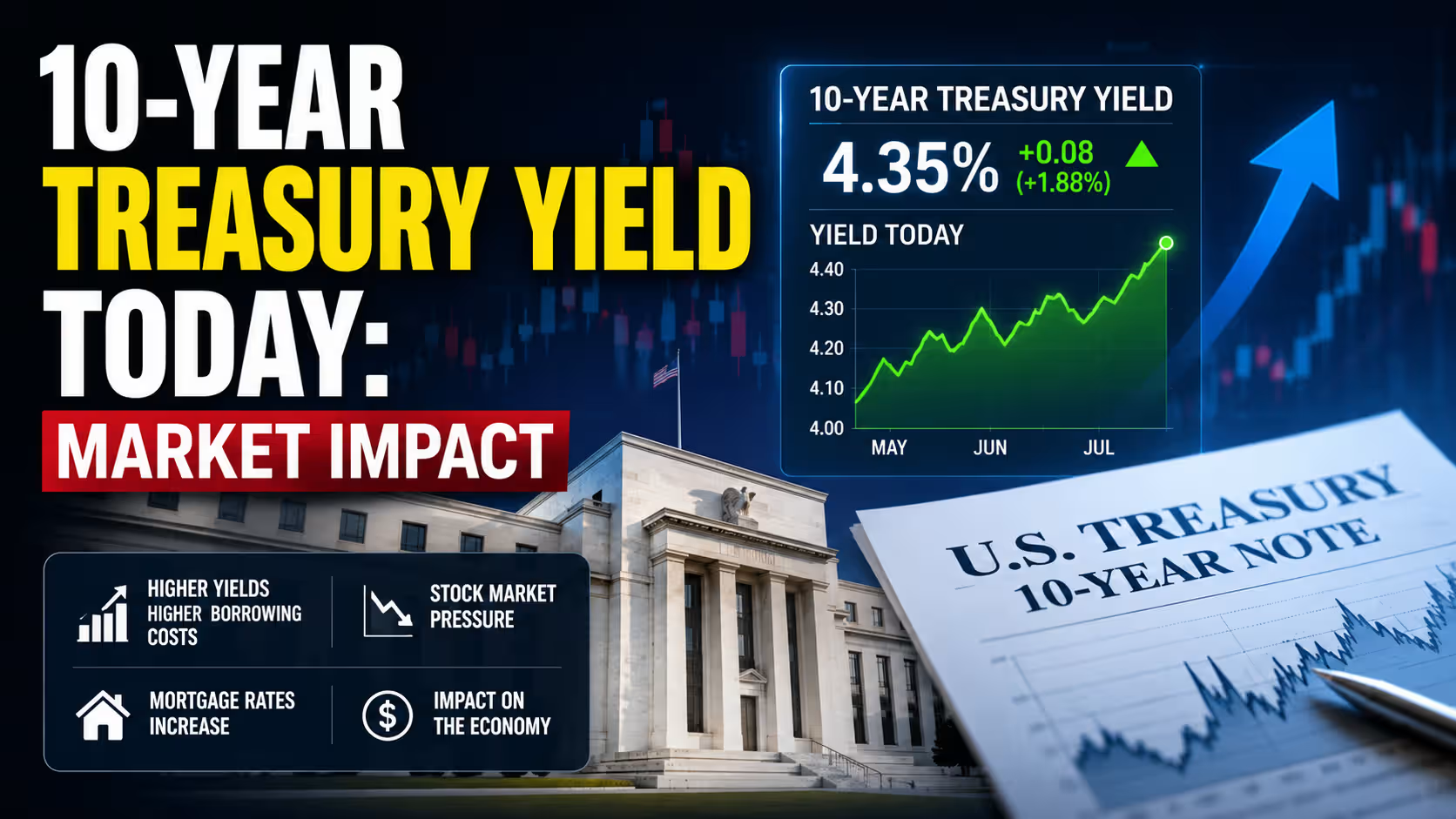
The 10-year US Treasury yield has held in a range of 4.0% to 4.5% for most of the past year. After the April meeting, two-year Treasury yields rose 0.10% and ten-year yields rose 0.08%, as investors digested the risk that high inflation could keep the Fed from cutting for much longer than expected.
How US Rates Move the Entire Global Bond Market
What happens to US Treasury yields does not stay in the US. It travels.
When Treasury yields rise, global investors earn more by holding US government bonds. That makes US debt more attractive compared to bonds from Europe, Japan, or emerging markets. To compete for capital, those countries often see their own bond yields rise too — or face the consequence of capital flowing out.
Rates market sentiment heading into the Iran conflict earlier this year was that central bank policy rates around the world would be unchanged or lower by end-2026. But the surge in oil prices and the resulting inflation shock forced a sharp hawkish repricing of central bank policy, especially in Europe.
Global sovereign bond yields moved in tandem with US Treasuries after the Fed’s April decision. Bond markets across the world are now pricing in the possibility that foreign central banks — including in Europe — may have to hike rates in 2026 to counter inflationary pressures driven by rising energy costs.
What the European Central Bank and Others Are Doing
The European Central Bank, the Bank of England, and the Bank of Canada each cut rates by 1.00% in 2025. The Reserve Bank of Australia cut by 0.75% over the same period. Those cuts reflected weaker economic conditions and the expectation that inflation was falling.
But the energy shock of 2026 has complicated their plans. Now that oil prices have surged and US rates are holding firm, European policymakers face a difficult choice: cut rates to support growth, or hold firm to fight inflation. Either decision carries risk, and the US rate environment is a major input into that calculation.
What Elevated US Rates Do to the US Dollar
When US interest rates stay high, the dollar tends to strengthen. Investors move money into the US to earn higher yields, and that demand pushes up the dollar’s value.
The US Dollar Index fell 9.4% in 2025, which actually helped foreign stocks outperform US stocks that year. But 2026 opened with fresh dollar weakness — the index touched a four-year low — before rebounding sharply after the Iran conflict began. As of late April 2026, the dollar had recovered to show a slight 0.4% gain for the year.
A stronger dollar matters for a simple reason: most global commodities, including oil, are priced in dollars. When the dollar rises, those goods become more expensive for everyone outside the US. Inflation gets exported to countries that had nothing to do with the Fed’s decisions.
The Hardest Hit: Developing Countries and Emerging Markets
No group feels the pressure of elevated US interest rates more sharply than developing and emerging market economies.
Here is why: about 80% of external debt in low- and middle-income countries is held in US dollars. When the dollar strengthens and US rates stay high, those countries have to pay back more expensive debt using weaker local currencies. Their borrowing costs rise. Their governments have less money to spend on healthcare, education, and infrastructure.
The OECD flagged this in its latest Global Debt Report. It found that when US dollar yields rise alongside dollar appreciation, the cost of imports goes up for countries that rely on foreign goods. Central banks in those countries are often forced to raise their own interest rates just to control inflation, even when their own economies are struggling.
Historical data makes the scale of this problem clear. From January 2022 to March 2023, during the last major US rate hike cycle, African currencies lost 8% of their value. That move alone increased those countries’ debt by the equivalent of 10% of GDP and pushed up the cost of imports significantly.
The World Economic Forum noted that developing countries already borrow at interest rates roughly three times higher than developed countries. Advanced nations have historically borrowed at around 1%, while the least developed countries often pay between 5% and 8%. Sustained high US rates widen that gap further.
When Emerging Markets Are More Resilient
Not all emerging markets suffer equally. Research published in the Journal of Money, Credit and Banking in 2026 found that the impact of US rate shocks depends heavily on domestic vulnerabilities.
Emerging markets with stronger monetary policy credibility and lower foreign-currency debt tend to weather US rate pressure much better. Their currencies depreciate less, capital outflows are smaller, and their economies stay more stable.
This was visible in 2025. Despite the elevated US rate environment, the MSCI Emerging Markets Index delivered a total return of 33.6% — outpacing both the S&P 500 (17.9%) and the MSCI World Index (21.6%). Countries with solid economic fundamentals proved they could absorb the pressure.
How Stock Markets Around the World Are Responding Today
Stock markets respond to US rates through two main channels: the cost of borrowing and the competition from bonds.
When rates stay high, companies pay more to borrow money for expansion, equipment, and operations. Higher costs reduce profits, and lower profits usually mean lower stock prices.
At the same time, high yields on US Treasuries make safe government bonds more attractive compared to stocks. Some investors shift money out of equities and into bonds, pulling stock prices lower.
After the Fed’s April 2026 hold, large US stocks as measured by the S&P 500 finished roughly flat. But small-cap stocks — which tend to be more sensitive to interest rates because they rely more heavily on borrowing — fell 0.6%, as measured by the Russell 2000. That split tells the story: the higher-rate environment hits the most interest-rate-sensitive parts of the market hardest.
Globally, sectors that perform best in high-rate environments include energy, utilities, industrials, and materials — all of which have pricing power in an inflationary economy. Technology stocks, which had led markets during low-rate years, have faced more pressure as the rate environment stays restrictive.
Latest Analysis: What Investors Should Watch
Several key indicators will tell you where this is heading.
The Fed’s next move: JPMorgan expects no cuts in 2026, with a possible 25-basis-point hike in Q3 2027. Barclays sees no cuts until March 2027. Goldman Sachs pushed its rate-cut forecast to December 2026. Watch for any signal that inflation is falling faster than expected — that would change the calculation quickly.
Oil prices: The Iran conflict is the primary driver of today’s inflation shock. If a peace deal or supply restoration brings oil prices lower, inflation expectations would fall, and rate-cut hopes would revive. That would shift global capital flows significantly.
The US dollar’s direction: The dollar’s strength or weakness is the transmission mechanism for US rate effects globally. A weaker dollar tends to relieve pressure on emerging markets and developing economies.
The new Fed Chair: Jerome Powell’s term as chair expired in May 2026. Kevin Warsh, seen as potentially more hawkish, is the incoming chair. The market is watching his early signals carefully. A shift in rhetoric could move global bond markets within hours of a single speech.
Foreign central bank responses: Watch the European Central Bank and the Bank of England. If they shift toward holding or hiking, European bond yields will rise, global capital flows will shift again, and currency markets will move accordingly.
What This Means for Everyday Investors
You do not need to be an economist to act on this information.
If you hold international investments, know that the US rate environment affects the returns on those holdings, partly through currency movements. A strengthening dollar can reduce the value of your foreign investments when converted back into dollars — and a weakening dollar can boost them.
If you hold bonds, remember that bond prices move opposite to yields. When US rates rise or stay high, bond prices tend to fall. Shorter-duration bonds carry less risk in this environment.
If you hold stocks, consider that sectors with strong pricing power — energy, industrials, utilities, healthcare — tend to hold up better when rates are elevated. Interest-rate-sensitive sectors like real estate and small-cap growth stocks tend to suffer more.
Always speak with a licensed financial advisor before making changes to your portfolio. The global rate environment is complex, and personal circumstances vary widely.
The US dollar is the world’s reserve currency, and most global trade and debt are priced in dollars. When the Fed raises or holds rates high, investors worldwide move money into US assets to earn higher returns. That capital flow strengthens the dollar, raises borrowing costs for other countries, and forces foreign central banks to respond — affecting bonds, currencies, and stock markets globally.
The Federal Reserve held the federal funds rate at 3.50%–3.75% at its April 28–29, 2026 meeting — the third consecutive meeting without a change. Markets are pricing in no rate cuts for the rest of 2026 and into 2027. The Fed is holding rates steady due to sticky inflation running near 3%, driven largely by the Iran conflict and elevated oil prices.
About 80% of external debt in low- and middle-income countries is held in US dollars. When the dollar strengthens due to high US rates, those countries must repay more expensive debt using weaker local currencies. Their borrowing costs rise, import prices go up, and governments are forced to cut spending on public services. Developing countries already pay interest rates three times higher than developed countries — and high US rates widen that gap further.
High US interest rates increase borrowing costs for companies, which reduces profits and weighs on share prices. They also make US Treasury bonds more attractive than stocks, pulling investment away from equities. Interest-rate-sensitive sectors like small-cap stocks and real estate tend to suffer most. After the Fed’s April 2026 hold, the Russell 2000 small-cap index fell 0.6%, while large-cap stocks held roughly flat.
As of May 2026, most major banks expect no rate cuts this year. Goldman Sachs pushed its forecast to December 2026, Barclays expects the first cut in March 2027, and JPMorgan sees the next move as a possible 25-basis-point hike in Q3 2027. The timeline depends heavily on whether oil prices fall and inflation returns to the Fed’s 2% target.
Not always. Research published in the Journal of Money, Credit and Banking in 2026 found that emerging markets with strong monetary credibility and lower foreign-currency debt hold up much better during US rate pressure. In 2025, the MSCI Emerging Markets Index delivered a 33.6% total return — outpacing both the S&P 500 (17.9%) and the MSCI World Index (21.6%), despite the elevated US rate environment.
Focus on sectors with strong pricing power, such as energy, industrials, utilities, and healthcare, which tend to perform better in high-rate environments. In bonds, shorter-duration holdings carry less risk when rates are elevated. For global holdings, watch the US dollar — a stronger dollar reduces the value of foreign investments when converted back to dollars. Always consult a licensed financial advisor for guidance tailored to your personal situation.