Sensex, Nifty, and Dow Move in Different Directions as Risk Sentiment Shifts
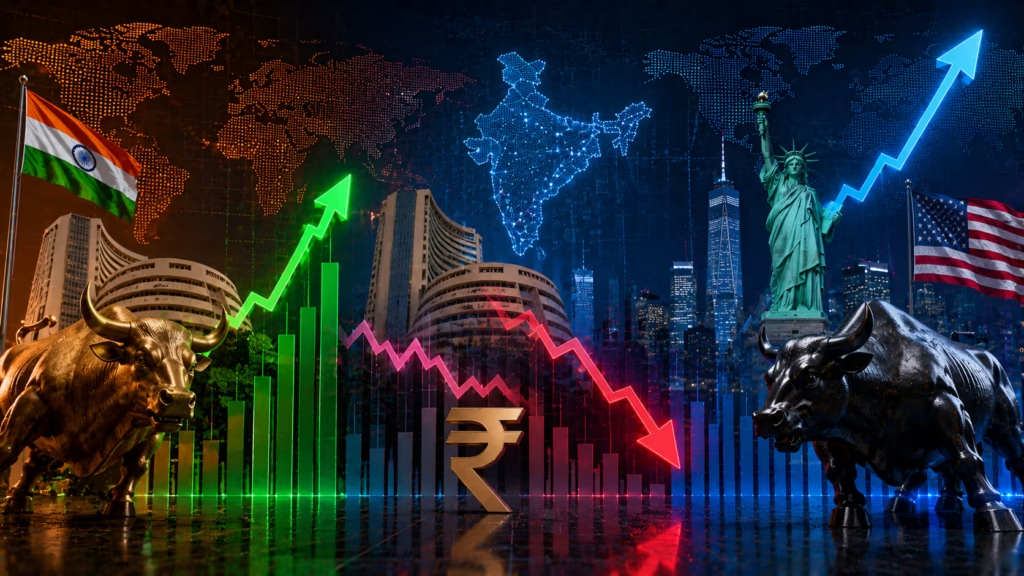
Global stock markets are not moving together right now. The Sensex, Nifty, and Dow are moving in different directions as risk sentiment shifts across markets, driven by a mix of oil price swings, geopolitical tensions, foreign fund flows, and a brand-new U.S. Federal Reserve chairman. Wall Street is hitting record highs. Indian markets are trading near multi-month lows. And the gap between the two tells a powerful story that every investor needs to understand right now.
Here is the complete picture — the latest numbers, the key reasons behind the divergence, and what it means for your money going into the week ahead.
Today’s Latest Numbers: Where Sensex, Nifty, and Dow Stand
On Friday, May 22, 2026, Indian and U.S. markets closed the week on a positive note — but the levels they reached tell very different stories.
The Sensex finished at 75,415.35, up 231.99 points or 0.31%. The Nifty 50 closed at 23,719.30, gaining 64.60 points or 0.27%. The standout performer was Nifty Bank, which surged 615.95 points or 1.15% to close at 54,055.35, acting as the key driver of the session’s gains.
Meanwhile, Wall Street had a much stronger day. The Dow Jones Industrial Average rose 276.31 points, or 0.55%, to 50,285.66 — marking a record closing high. The S&P 500 gained 0.17% to 7,445.72, and the Nasdaq Composite added 0.09% to 26,293.10.
Both markets ended in the green on Friday. But look at the absolute levels and the year-to-date journey, and a clear divergence comes into focus. The Dow is hitting all-time highs. The Sensex is still more than 10,000 points below its November 2025 peak of 86,055.
Sensex, Nifty, and Dow Move in Different Directions as Risk Sentiment Shifts: The Full Analysis
This divergence is not random. Six specific forces are pulling Indian and American markets in opposite directions.
1. Oil Prices Are Hitting India Harder
India is one of the world’s largest oil importers. When crude oil prices rise, India feels it more than the U.S. does.
Brent crude futures hovered near $104 to $105 per barrel through the week of May 18-22, 2026. The situation around the Strait of Hormuz — a critical global oil transit corridor — continues to embed a significant risk premium, keeping energy markets tight and prone to volatility.
High oil prices hurt India in multiple ways. They push inflation higher, weaken the Indian rupee, and reduce returns for foreign investors in dollar terms. For the U.S., oil above $100 is a concern, but the country is now a net energy producer, which cushions the blow.
2. FII Outflows Are Draining Indian Markets
The single biggest pressure on the Sensex and Nifty in 2026 has been the relentless selling by Foreign Institutional Investors (FIIs).
Foreign investors withdrew $22.2 billion from Indian equities in under three months — exceeding last year’s record annual outflows and signaling heightened caution over the market and global economic outlook.
That kind of selling creates a structural headwind. Every time global uncertainty rises — whether it is bond yields spiking or oil prices surging — foreign money flows out of emerging markets like India and moves back into the perceived safety of U.S. assets.
The market tone remains range-bound. Strong DII inflows are cushioning the downside and persistent FII selling is limiting the upside. The market is in a buy-on-dips and sell-on-rallies pattern.
3. DII Buying Is India’s Safety Net
While FIIs are leaving, Domestic Institutional Investors (DIIs) — primarily Indian mutual funds backed by retail investors — continue to buy. This steady support has prevented a sharper correction and kept the Sensex and Nifty from breaking down below critical levels.
A sustained uptrend will likely require geopolitical stability and softer oil prices, which would strengthen macro conditions and improve FII sentiment, especially as corporates head into a weak Q1FY27.
In simple terms: DIIs are holding the floor. But only a reversal in FII flows can push markets meaningfully higher.
4. The RBI Dividend Boost
One major positive for Indian market sentiment this week was the RBI’s record surplus transfer of ₹2.87 lakh crore to the Central Government for the financial year 2025-26. This figure significantly exceeds previous years and gives the government additional fiscal room without needing to borrow more, which is a positive for bond markets and equities alike.
This was a meaningful domestic catalyst that helped the Sensex and Nifty recover on Friday.
5. U.S.-Iran Diplomacy — Moving Markets on Both Sides
Hopes of progress in the U.S.-Iran peace negotiations added to markets’ optimism on Friday. Markets are watching whether Washington and Tehran can advance negotiations on uranium enrichment and shipping access through the Strait of Hormuz.
When Iran talks improve, oil prices fall. And when oil falls, Indian markets tend to bounce — as they did on April 8, 2026, when the Sensex surged about 3.6% after a U.S.-Iran ceasefire eased geopolitical tensions and pushed oil below $100 per barrel.
The inverse is also true. When Iran talks stall or worsen, oil spikes, FIIs pull back from India, the rupee weakens, and Indian markets fall while U.S. markets remain relatively insulated.
6. New Fed Chair and U.S. Bond Yields
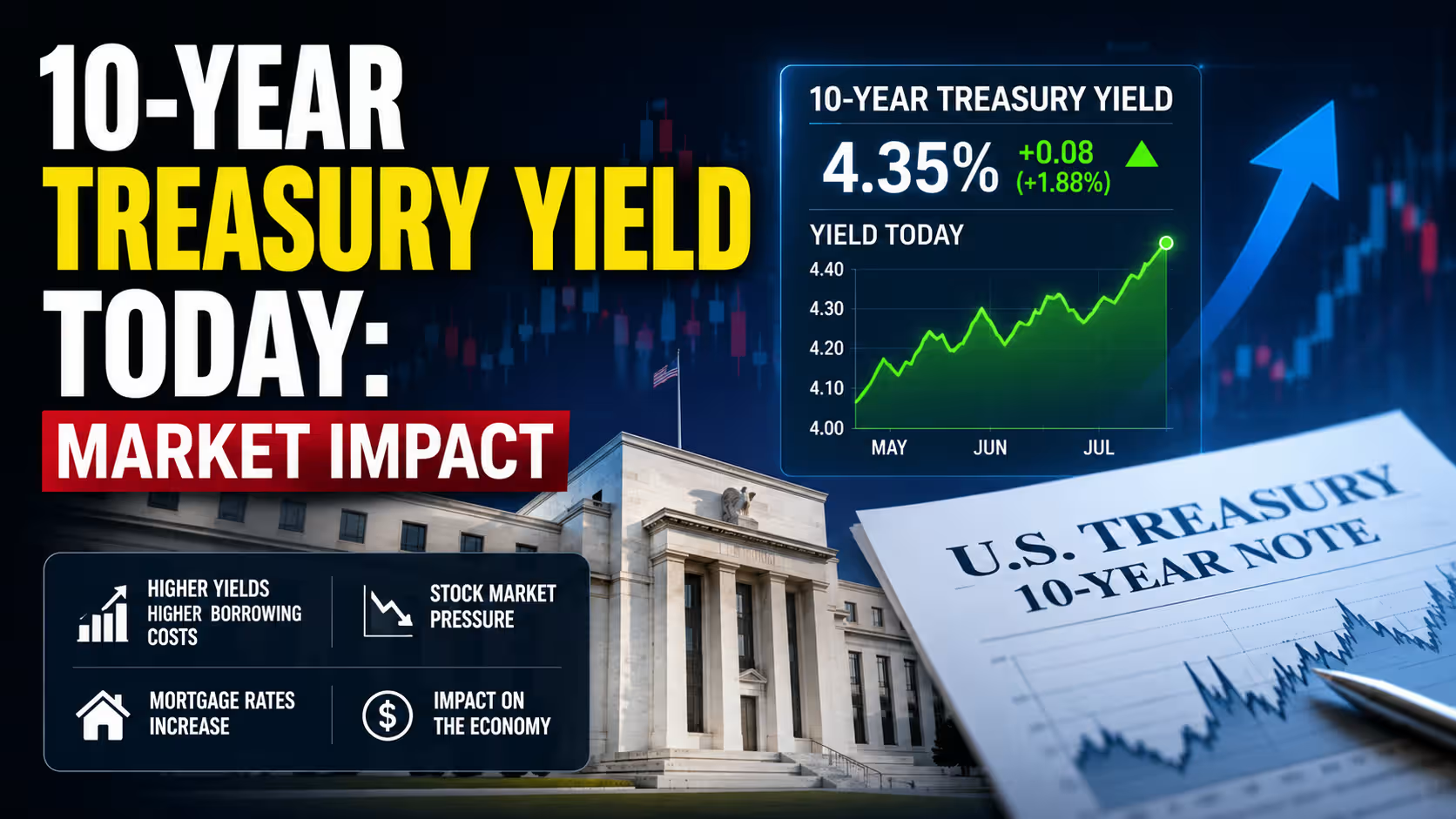
Kevin Warsh took the oath as the new U.S. Federal Reserve chairman on May 22, 2026. His arrival comes as the 30-year U.S. Treasury yield has hit a nearly 19-year high, driven by Middle East inflation pressures.
High long-term bond yields in the U.S. pull capital toward dollar-denominated assets and away from emerging markets like India. Markets remain cautious in the near term, amid an unfavourable macro backdrop marked by continued weakness in the rupee, elevated Brent crude prices and high U.S. bond yields, all of which are tightening financial conditions and weighing on sentiment.
Why Dow Is at Record Highs While Sensex Lags: A Deeper Look
The Dow Jones is trading at all-time record highs while the Sensex is roughly 10,000 points below its peak. Understanding why matters for any investor watching both markets.
The rally in U.S. markets is supported by a resilient economy, strong corporate earnings boosted by AI-driven returns, and relatively positive consumer spending. This past earnings season has proven that companies are starting to see strong returns on their AI investment.
India’s situation is more complicated. The BSE Sensex experienced a sharp correction in the first quarter of 2026, driven by elevated global interest rates, rupee volatility, and concerns about FII outflows. The subsequent recovery has been steady but unspectacular.
At its November 2025 high, the Sensex briefly touched 86,055 — a level that brokerages were pointing to as the launchpad for a run toward 94,000 (HSBC target) or even 107,000 (Morgan Stanley’s optimistic case) by end-2026. Instead, geopolitical shocks and capital outflows rewrote the script.
The divergence also comes down to currency sensitivity. Significant rupee depreciation — which can occur when oil prices rise sharply, given India’s large energy import bill — reduces the USD-equivalent returns available to foreign investors and can trigger capital outflows that weigh on equities and the currency simultaneously.
What India’s Key Technical Levels Say Right Now
Technical analysts watching the Sensex and Nifty are focused on specific thresholds that will determine the near-term direction.
For the Sensex, 74,400–74,500 is likely to act as an immediate support zone, while 76,100–76,200 may remain a key resistance area.
For the Nifty 50, the index needs to move decisively above 23,800 to witness a directional rally and improve near-term sentiment. Near-term support levels sit at 23,317–23,482.
For the Nifty Bank, the index needs to form higher highs and higher lows on a sustained basis in the daily chart, with a move above the breakdown area of 54,400–54,700 required to signal a pause in the recent downtrend. Key support is placed at 52,700–52,400 levels.
Breaking above resistance would likely require a combination of falling oil prices, easing U.S. bond yields, or a clear reversal in FII flows.
What to Watch This Week: Prediction for May 26-29, 2026
The NYSE is closed on Monday, May 25, for Memorial Day. Indian markets resume Tuesday. Here is what will drive price action this week.
US-Iran Negotiations
The most important single variable for Indian markets right now is the outcome of U.S.-Iran diplomacy. Any concrete progress toward a peace deal or a sustained ceasefire would push oil prices lower, ease inflation pressure in India, and likely bring FIIs back to Indian markets. Watch for any official statements from Washington or Tehran.
Oil Price Direction
Brent crude near $104–$105 per barrel is still significantly above the comfort zone for India. A drop toward $90 or below would fundamentally change the macro picture for Indian equities — cutting inflation expectations, supporting the rupee, and drawing FII interest back.
Key U.S. Earnings
Earnings from Salesforce, Dell Technologies, Costco, and Dollar Tree this week could shape U.S. market sentiment. Any disappointing commentary on the consumer or corporate spending could push the Dow off record highs and increase global risk aversion — which would indirectly pull Indian markets lower.
India Q1FY27 Macro Data
Markets will closely track upcoming domestic macroeconomic data. Corporates are heading into a seasonally weak Q1FY27 quarter, and any signs of earnings pressure could add to selling pressure on the Sensex and Nifty.
The Rupee
Watch for rupee stability. Any significant rupee depreciation from current levels would be a negative for FII flows and equity sentiment. Any strengthening of the rupee — which happened on May 22 and helped the Sensex rebound — would be a green flag.
What This Divergence Means for Investors
Whether you invest in Indian or global markets, here are clear takeaways from the current setup.
For Indian Investors
Indian markets are in a “wait and see” mode. The fundamentals — RBI dividend, strong DII flows, banking sector resilience — provide support. But sustained upside needs either oil falling or FIIs returning. Do not fight the range-bound market. Use dips toward key support levels as accumulation opportunities in quality large-cap stocks.
India’s export sector, particularly in pharmaceuticals, chemicals, textiles, and IT services, stands to benefit substantially from improved U.S. market access through a potential trade framework. Any concrete progress on a U.S.-India trade agreement would be a powerful positive catalyst for Indian equities.
For Global Investors Watching India
The India story is still intact over the long term. Bernstein analysis suggests that Indian markets tend to show strong alternate cycles with U.S. and Chinese markets — with the underperformance phase pointing toward a potential outperformance in 2026. The current correction may be creating entry opportunities for long-term investors.
For U.S.-Focused Investors
Wall Street is at record highs, but the macro backdrop underneath is more complex than the index levels suggest. Near-19-year-high bond yields, a new Fed chair, oil near $100 per barrel, and a historically weak June ahead (the S&P 500 loses an average of 2.1% in June during midterm election years) all counsel caution. Diversification and position sizing matter here.
Final Thoughts
The Sensex, Nifty, and Dow are moving in different directions as risk sentiment shifts — and that tells you something important about where global capital is flowing right now. Money is sitting in U.S. assets, lifted by strong earnings and domestic resilience. It is leaving India, pressured by oil, bond yields, and geopolitical uncertainty.
That divergence will not last forever. History shows that Indian markets and U.S. markets run in alternating cycles. The patient investor who understands what is driving the split — and prepares for a reversal — will be better positioned when the tide turns.
Stay informed, watch the oil price, and keep an eye on U.S.-Iran diplomacy. Those two variables will likely decide which direction all three indices move next.
This article is for informational purposes only and does not constitute financial or investment advice. Always consult a qualified financial advisor before making investment decisions.
The divergence is driven by several factors. The Dow Jones is hitting record highs because the U.S. economy remains resilient, corporate earnings are strong, and AI-driven growth is boosting tech stocks. The Sensex and Nifty are underperforming because India faces elevated oil prices near $104 per barrel, record FII outflows of $22.2 billion in under three months, a weakening rupee, and the pressure of high U.S. bond yields pulling capital away from emerging markets.
On May 22, 2026, the Sensex closed at 75,415.35, gaining 231.99 points or 0.31%. The Nifty 50 ended the session at 23,719.30, up 64.60 points or 0.27%. The Nifty Bank was the standout performer, rising 615.95 points or 1.15% to close at 54,055.35. The Dow Jones Industrial Average closed at a record high of 50,285.66 on the same day.
India is one of the world’s largest oil importers. When global crude prices rise, India pays more for energy imports, which pushes domestic inflation higher and weakens the Indian rupee. A weaker rupee reduces the USD-equivalent returns available to foreign investors, which triggers FII outflows and puts pressure on the Sensex and Nifty. The U.S., by contrast, is now a net energy producer, so rising oil prices have a smaller negative impact and can even benefit some U.S. energy stocks.
The Reserve Bank of India transferred a record surplus of ₹2.87 lakh crore to the Central Government for the financial year 2025-26. This transfer gives the government additional fiscal room without needing to borrow more from financial markets, which reduces upward pressure on Indian bond yields. It also signals a healthy RBI balance sheet and provides a boost to domestic sentiment, which helped push the Sensex and Nifty higher on May 22, 2026.
GIFT Nifty refers to Nifty 50 index futures traded on the NSE International Exchange in GIFT City, Gujarat. Because GIFT Nifty trades outside regular Indian market hours, it reflects overnight global developments — including movements in U.S. markets, Asian markets, oil prices, and currency moves. Traders and analysts use GIFT Nifty futures as an early indicator of where the Nifty 50 and Sensex are likely to open the next morning. A rising GIFT Nifty suggests a positive open; a falling one signals a gap-down start.
The BSE Sensex is the benchmark index of the Bombay Stock Exchange and comprises 30 well-established, financially sound Indian companies. The NSE Nifty 50 is the flagship index of the National Stock Exchange and tracks the performance of the 50 largest and most liquid Indian companies across 12 diverse sectors. Neither is considered better — the Nifty 50 is more diversified with 50 stocks, while the Sensex tracks 30. Both move in broadly the same direction but can diverge slightly based on sector composition and sector-specific events.
It is possible. Bernstein analysis notes that Indian markets tend to show strong alternate cycles relative to the U.S. market — typically running 2–3 years of continuous underperformance followed by a year of sharp outperformance. Since the Nifty has underperformed the S&P 500 in dollar terms for the past three years, this pattern historically points toward a potential reversal. Key conditions needed for outperformance include falling oil prices, a reversal in FII flows back to India, and progress on a U.S.-India bilateral trade deal. Morgan Stanley set a bull-case Sensex target of 107,000 by December 2026.