Iran Tensions Spike 550%: How Geopolitical Risk Is Moving Stocks and Crypto Today
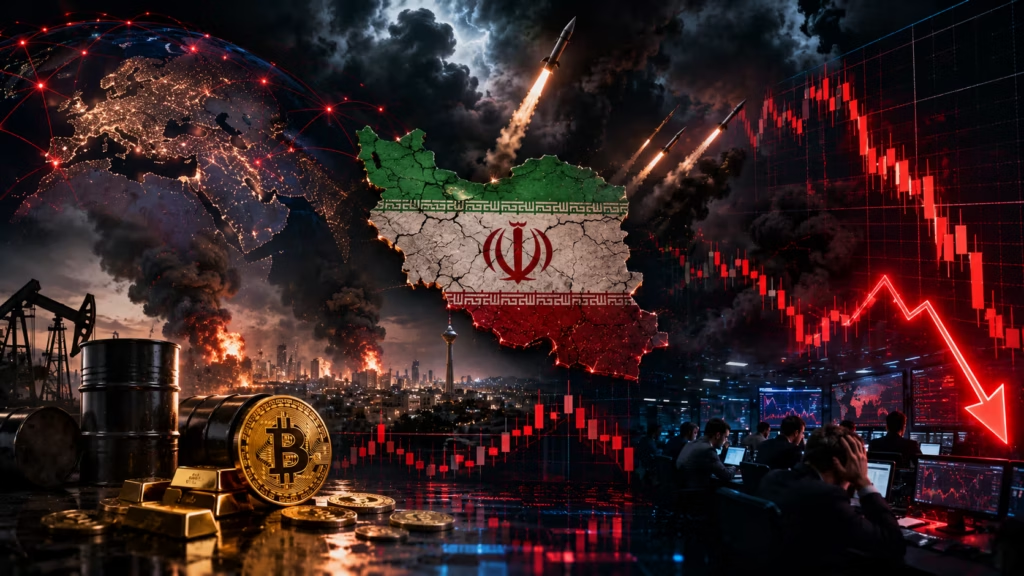
When Iran tensions spike, global markets feel it fast. Search interest in Iran-related market risk surged more than 550% in mid-2025 and again in early 2026, according to trend-tracking data — and for good reason. From a sharp rise in oil prices to Bitcoin dropping thousands of dollars in hours, the Iran conflict has become one of the most significant forces moving stocks and crypto today. This article explains exactly what happened, how different markets reacted, and what investors need to know right now.
A Quick Timeline: What Sparked the Latest Market Shock
The chain of events that rattled global markets began escalating in mid-2025 and intensified into early 2026.
In June 2025, Israel launched what became known as “Operation Midnight Hammer” — airstrikes targeting Iranian nuclear facilities. The U.S. followed with its own targeted strikes shortly after. Bitcoin fell sharply on the news, crypto markets saw over $250 billion in market cap wiped out, and oil prices jumped nearly 18% over two weeks.
The situation intensified again on February 28, 2026, when the United States and Israel launched coordinated military operations against Iran after Tehran rejected U.S. demands to scale back its nuclear program. President Trump confirmed the strikes publicly and markets — which were closed for the weekend — left crypto to absorb the initial shock alone.
By March 2026, oil prices had soared past $100 per barrel for the first time since 2022. Gold hit unprecedented levels above $5,400 per ounce. And the ripple effects spread across every major asset class on the planet.
Iran Tensions Spike 550%: How Geopolitical Risk Is Moving Stocks and Crypto Today
To understand why this conflict moves markets so dramatically, you need to understand two things: oil and the Strait of Hormuz.
The Strait of Hormuz: Why It Matters So Much
The Strait of Hormuz is a narrow waterway between Iran and the Arabian Peninsula. It handles roughly 20% of all global oil trade — about 20 million barrels per day, according to the U.S. Energy Information Administration. There is no practical short-term alternative route at that scale.
When Iran threatens to close the Strait — or when military activity near it increases — traders immediately price in the possibility of a global supply disruption. Even the fear of closure, without any actual stoppage, is enough to send oil prices sharply higher.
Iran itself produced around 3.5 million barrels per day of crude oil in 2025, representing about 4% of global supply according to Goldman Sachs Research. That production, combined with its control of the Strait, makes Iran the single most consequential wildcard in the global energy market.
As one energy analyst at the University of Texas put it: “Iran’s at the nerve center of the global oil market. If there’s a physical supply disruption, the market will react in a big way.”
How Oil Markets Reacted
The oil market’s reaction to each escalation has been swift and significant.
When Israeli airstrikes hit Iranian nuclear facilities in June 2025, Brent crude rose from around $65 per barrel to the low $80s almost immediately — a roughly 18% move in two weeks.
After the February 28, 2026 U.S.-Israel operation, oil surged even more aggressively. Brent crude jumped over 6% in a single session, hitting $77.50, its biggest one-day move since Russia’s invasion of Ukraine in 2022. By March 9, 2026, oil crossed $100 per barrel for the first time in years as the Strait of Hormuz effectively stopped commercial traffic.
Goldman Sachs later noted that around 14.5 million barrels per day of Persian Gulf crude production had been taken offline at the peak of disruption, pushing global oil inventories into a record drawdown of 11 to 12 million barrels per day in April.
By early May 2026, Brent crude had surged 37% since before the February operation began, according to Euronews. Goldman Sachs upgraded its Q4 2026 Brent crude forecast to $90 per barrel.
These oil price moves matter far beyond energy. Higher oil raises the cost of shipping, manufacturing, food production, and transportation. That feeds directly into inflation — and inflation changes how central banks behave.
How Stock Markets Reacted
The Initial Selloff
When U.S. stock markets opened after the February 2026 strikes, the reaction was sharp. The Dow, S&P 500, and Nasdaq all fell, with U.S. stock futures dropping around 1% in the first session. The S&P 500 recorded five consecutive weekly losses, falling about 2.1% in one week alone according to Julius Baer.
Sectors That Fell
Airlines, logistics companies, paint manufacturers, and any business with high fuel costs sold off quickly. Higher oil means higher operating costs, and those businesses have limited ability to absorb them overnight.
Consumer stocks also faced pressure as inflation fears grew. If oil stays elevated for months, household budgets tighten, and consumer spending tends to slow.
Sectors That Rose
Defense stocks moved in the opposite direction. Lockheed Martin and other aerospace and defense contractors climbed as investors priced in increased military spending. The logic is straightforward: geopolitical conflict of this scale almost always leads to higher government defense budgets, both in the U.S. and among allied nations.
Energy stocks outperformed broadly. Oil producers, refiners, and energy infrastructure companies benefited directly from the spike in crude prices.
The Surprising Recovery
Despite the severity of events, equity markets showed striking resilience. According to JPMorgan’s analysis, the U.S.-Iran conflict introduced elevated tail risks but also triggered aggressive “buy the dip” positioning among institutional investors. The S&P 500 actually hit record levels in April 2026, driven by recurring optimism around ceasefire negotiations and strong corporate earnings outside the energy sector.
The Nasdaq Composite gained 9.79% from when the conflict began through early May 2026, while the S&P 500 rose 4.29% over the same period. Emerging markets also held up: Taiwan’s Weighted Index gained 11.6%, South Korea’s KOSPI rose 6.36%, and Japan’s Nikkei added 1.81%.
This recovery pattern is consistent with how markets have historically handled geopolitical shocks — a sharp initial sell-off, followed by stabilization once investors see that core economic activity remains intact.
How Crypto Reacted: Bitcoin and Ethereum Under Pressure
Crypto markets have a unique role in geopolitical crises: they trade 24 hours a day, 7 days a week. That means they are always the first to price in a shock that happens over a weekend when traditional markets are closed.
Bitcoin’s Reaction
When the June 2025 Israeli strikes hit, Bitcoin fell sharply. It had been trading near all-time highs, hitting approximately $112,000 in May 2025. After the strikes, it fell below $100,000, dropping about 4% in 24 hours.
In the February 2026 escalation, Bitcoin dropped further and faster. It fell from around $68,000 to below $64,000 within hours of the Trump announcement — a nearly 3% decline in a single day, with an intraday low of $63,177 according to CoinGecko data.
Ethereum was hit harder than Bitcoin. It lost nearly 5% in a single day, briefly trading below $1,867. Solana fell 4.1% to $84. XRP dropped 3.6% to $1.36. Across seven days of sustained tension, Solana led losses among major tokens at 8.1% down.
Over $250 billion in total crypto market cap was wiped out during the June 2025 shock alone.
Why Crypto Drops Instead of Rising During Conflicts
Many people expect Bitcoin to act as a safe haven — a “digital gold” that rises when the world feels unstable. But the evidence from Iran-related events shows the opposite.
When geopolitical risk spikes suddenly, investors across all markets want liquidity and certainty. They sell volatile assets — including crypto — and move into traditional safe havens like physical gold, U.S. Treasuries, the Japanese yen, and the Swiss franc.
“We’re already starting to see the uncertainty there weigh on crypto and equity markets,” said Carlos Guzman of GSR Research. The key issue is that crypto lacks the long track record and institutional trust that gold has built over centuries as a conflict hedge.
Crypto does recover. After Trump signaled a pause in attacks in June 2025, Bitcoin prices bounced back. But the initial reaction is consistently to sell, not to buy.
Crypto as a 24/7 Indicator
One fascinating development: crypto exchanges are now being used as real-time indicators for how traditional markets will open on Monday. Traders used perpetual futures on crypto exchange Hyperliquid over a tense weekend in March 2026 to price oil, gold, and silver around the clock. Oil futures on the platform jumped about 5% to $70.6 per barrel, gold futures rose 1.3%, and silver added 2% — all before mainstream markets had opened.
This shows crypto’s evolving role: not as a safe haven itself, but as a 24/7 price discovery mechanism for global risk.
Safe-Haven Assets: What Investors Are Buying Instead
When stocks fall and crypto drops, capital flows into assets with a long history of holding value during crises.
Gold
Gold has been the clearest winner from the Iran escalations. Following the February 2026 operation, gold prices surged above $5,400 per ounce. Earlier, in late January 2026, gold had already crossed $5,000 per ounce — a historic milestone — as investors positioned for conflict.
GLD (SPDR Gold Shares) ETF climbed steadily as capital rotated out of riskier positions into gold exposure.
U.S. Treasuries
JPMorgan Research highlighted U.S. investment-grade corporate bonds and Treasuries as favored safe-haven assets during this period, benefiting from tightening credit spreads despite the geopolitical stress.
The U.S. Dollar — With a Twist
Traditionally, the dollar strengthens in crises. This time, the dynamic was more complex. The U.S. dollar remained under pressure due to ballooning fiscal deficits and inflation fears driven by the very oil surge the conflict created. This unusual situation helped gold decouple from the dollar and attract even more safe-haven flows on its own.
Inflation and Interest Rate Implications
The Iran conflict is not just a geopolitical story. It is also a monetary policy story.
Higher oil prices feed directly into headline inflation. One estimate from Goldman Sachs suggested that an oil spike to $120 per barrel could add 1.7% to U.S. headline CPI, all else equal.
According to analysis from Al Habtoor Research Centre, the conflict pushed headline inflation 1.3 percentage points above the pre-conflict baseline by December 2025. Global brokerages began scaling back their expectations for Federal Reserve rate cuts in 2026, with some forecasts shifting from two expected cuts to zero.
That matters for investors in several ways. Higher-for-longer interest rates pressure growth stocks, increase borrowing costs for consumers and businesses, and reduce the appeal of assets like crypto and speculative equities.
J.P. Morgan Global Research estimated that if Brent prices stayed at $80 per barrel through mid-year, global GDP growth for the first half of 2026 could be depressed by an annualized rate of 0.6%.
Latest Analysis: Where Markets Stand Today
As of May 2026, the conflict has moved into a tense, drawn-out phase. President Trump described the ceasefire as on “life support” after Iran rejected a U.S. peace proposal. Shipping through the Strait of Hormuz remains paralyzed, and global brokerages are watching the waterway closely.
Markets have largely priced in a medium-term disruption and are now trading around whether the Strait reopens or stays closed. If it reopens, analysts expect a sharp reversal — energy prices fall, defense stocks rotate lower, and risk assets recover. If it stays closed, the stagflation scenario — high inflation combined with slower growth — becomes harder to dismiss.
The VIX, Wall Street’s fear gauge, remains elevated, reflecting fragile market sentiment and potential for sharp swings in either direction.
For investors today, the key question is not whether Iran tensions are affecting markets — they clearly are. The question is how long the physical disruption lasts, and whether diplomacy or further escalation determines the next chapter.
What Smart Investors Are Doing Right Now
Based on current market analysis from major institutions, here is how sophisticated investors are positioning:
Staying selective in energy: Upstream oil producers with low debt and domestic production are outperforming. Companies tied to Gulf energy logistics face more direct risk.
Increasing gold exposure: GLD and physical gold have attracted consistent inflows as inflation and uncertainty persist.
Watching defense closely: Lockheed Martin and major defense contractors have seen sentiment and order expectations improve. But prices already reflect much of the geopolitical premium.
Reducing exposure to fuel-sensitive sectors: Airlines, paint manufacturers, logistics companies, and consumer-facing businesses with thin margins are more vulnerable to sustained oil prices.
Holding cash or Treasuries: Institutional investors are maintaining liquidity and disciplined patience. In high-uncertainty environments, the ability to act quickly when the situation clears is valuable.
On crypto: Most analysts advise caution in the near term. Bitcoin needs a stabilization in global risk sentiment before it can regain sustained upward momentum.
FAQ
Iran controls the Strait of Hormuz, a narrow waterway through which roughly 20% of all global oil trade flows — about 20 million barrels per day. When conflict escalates near this chokepoint, traders price in the risk of supply disruption, even before any actual stoppage. Iran also produces about 3.5 million barrels per day of crude oil, representing around 4% of global supply. Any threat to either the Strait or Iranian production pushes oil prices sharply higher.
The Iran conflict affects stocks through several channels. Higher oil raises costs for airlines, logistics, and consumer businesses, hurting their earnings. Inflation fears caused by oil spikes can delay central bank rate cuts, pressuring growth stocks. Meanwhile, defense stocks and energy producers tend to benefit. Historically, markets sell off sharply at first but recover once investors see that core economic activity continues — a pattern repeated in 2025 and early 2026.
Based on events in 2025 and 2026, Bitcoin has consistently dropped when Iran tensions escalate suddenly. When Israel struck Iran in June 2025, Bitcoin fell below $100,000 from near all-time highs. In the February 2026 U.S.-Israel operation, Bitcoin dropped from around $68,000 to below $64,000 within hours. Investors in geopolitical crises tend to sell volatile assets and move into traditional safe havens like gold and government bonds rather than crypto.
A safe-haven asset is one that tends to hold or increase its value when markets are stressed. During the Iran escalations of 2025–2026, gold was the clearest beneficiary, rising above $5,400 per ounce. U.S. Treasuries and investment-grade bonds also attracted inflows. The Swiss franc and Japanese yen strengthened. Defense stocks also performed well. Bitcoin, by contrast, did not act as a safe haven and fell with broader risk assets during each escalation.
A full Strait of Hormuz closure would be unprecedented and extremely difficult for the market to absorb. Goldman Sachs estimated that an oil spike to $120 per barrel could add 1.7% to U.S. headline CPI on its own. Sustained disruption would raise costs across shipping, manufacturing, food production, and transportation globally. This could force central banks to keep interest rates higher for longer, slowing economic growth and tightening financial conditions for consumers and businesses.
Stock markets demonstrated surprising resilience because most institutional investors distinguished between short-term geopolitical volatility and actual long-term economic damage. Corporate earnings outside the energy sector remained strong. Aggressive ‘buy the dip’ positioning by large investors also supported prices. The Nasdaq gained 9.79% and the S&P 500 rose 4.29% from when the conflict began through early May 2026, as recurring optimism around ceasefire negotiations supported market confidence.
Financial advisors generally recommend staying calm and avoiding panic-driven decisions during geopolitical spikes. Diversification across asset classes — including some exposure to energy, defense, gold, and safe-haven assets — helps cushion portfolio swings. Reducing concentration in fuel-sensitive sectors like airlines and logistics can lower direct exposure. For long-term investors, history shows that markets tend to recover from geopolitical shocks once the immediate uncertainty clears. Always consult a qualified financial advisor before making investment changes.