Most people have never heard of a credit default swap until a financial crisis puts it on the front page. Yet this single financial instrument helped amplify the 2008 global financial crisis into the worst economic meltdown in a generation — and today, in 2025 and 2026, CDS contracts are back in the news as investors rush to buy protection against U.S. government debt. So what is a credit default swap and how does it work? This guide answers that question in plain, simple language — no finance degree required.
What Is a Credit Default Swap and How Does It Work?
A credit default swap (CDS) is a financial contract between two parties where one side pays the other a regular fee in exchange for protection if a specific borrower fails to repay their debt.
Think of it this way. Imagine you lent someone $10 million, but you are worried they might not pay you back. You find a third party — a bank or insurance company — and strike a deal: you pay them a small fee every quarter, and in return, if the borrower defaults, the third party pays you back the full $10 million.
That deal is a credit default swap. The borrower whose debt you are insuring is called the reference entity. The event that triggers a payout — usually a default, bankruptcy, or failure to pay — is called a credit event. The amount of debt being protected is called the notional amount.
It is, in the most basic sense, insurance on a loan. But it has some critical differences from regular insurance — and those differences matter enormously.
The Three Main Players in a CDS Contract
The Protection Buyer
The protection buyer is the party paying the regular fee. They own a bond or loan and want to protect themselves if the borrower defaults. They pay a quarterly or semi-annual premium — known as the CDS spread — to the protection seller. By buying protection, they are effectively betting that the borrower’s creditworthiness will deteriorate.
The Protection Seller
The protection seller receives the regular fee and agrees to pay out if a credit event occurs. They are taking on the credit risk of the reference entity. Selling protection is equivalent to taking a long position — like an investor going long on a company’s bonds. Banks, insurance companies, and hedge funds commonly play this role.
The Reference Entity
The reference entity is the company, government, or institution whose debt is being insured. They are not a party to the CDS contract at all — they do not sign it, they do not know it exists, and they do not receive any money from it. CDS contracts exist entirely between the buyer and seller.
A Simple, Real-World CDS Example
Here is how a standard credit default swap works step by step.
A pension fund holds $10 million worth of corporate bonds issued by a large retail company. The fund manager is worried the company might default. The fund manager approaches a bank and buys a 5-year CDS on that $10 million of bonds.
The agreed spread is 200 basis points annually. One basis point equals $1,000 on a $10 million notional contract per year. So the pension fund pays the bank 200 × $1,000 = $200,000 per year, typically split into quarterly payments of $50,000.
Three years into the contract, the retail company files for bankruptcy — a clear credit event. The bank now owes the pension fund the full $10 million notional value, minus whatever the bonds are worth in recovery (say, 40 cents on the dollar). The pension fund receives $6 million from the bank — the $10 million notional minus the $4 million recovery value — and its original investment is protected.
That is a physical settlement example. In a cash settlement, the bank simply pays the difference between the bond’s par value and its post-default market price, without any bonds changing hands.
What Are CDS Spreads and Why Do They Matter?
The CDS spread — the price of the insurance — is one of the most important signals in global financial markets. It is quoted in basis points per year.
When a CDS spread rises, it means the market believes the reference entity is becoming more likely to default. When it falls, confidence in the borrower is improving.
Traders, central bankers, and regulators watch CDS spreads closely as a real-time barometer of credit risk. They are not opinions — they represent actual money being paid to hedge real exposure, which makes them some of the most honest price signals in markets.
Here is a real example from today. As of May 2025, spreads on U.S. one-year credit default swaps rose to 52 basis points — up sharply from 16 basis points at the start of the year. That means the cost of insuring $10 million of U.S. government debt for one year jumped from $16,000 to $52,000. Analysts at Invesco and other major financial firms attributed the spike to growing investor anxiety about the unresolved U.S. debt ceiling. The same pattern appeared during the 2023 debt ceiling crisis, the 2025 government shutdown, and again when tariff announcements added fiscal uncertainty.
These widening spreads are a “hedge against political risk, not insolvency,” according to market analysts — but they are still a meaningful signal that professional investors are paying real money for protection against a scenario that most would have once considered unthinkable.
CDS Spreads vs. CDS Prices: Understanding the Difference
There are two ways to express the cost of a CDS contract.
The spread is the annual fee expressed in basis points as a percentage of the notional amount. It is the ongoing cost of maintaining the contract. A spread of 100 basis points means you pay 1% of the notional amount per year.
For many standardized CDS contracts — particularly after reforms introduced following the 2008 crisis — a fixed coupon of either 100 or 500 basis points is used, and the difference between what you should pay and what the fixed coupon implies is settled upfront in cash. This is called the upfront payment. If the spread is higher than the fixed coupon, the buyer pays an upfront premium to the seller.
This standardization, introduced across the industry from 2009 onward, made the market more transparent and easier to manage.
What CDS Are Used For: Three Main Purposes
1. Hedging Credit Risk
The most legitimate and widely used purpose. A bank that has lent money to a company can buy a CDS to protect itself if that company defaults. A pension fund holding corporate or government bonds can do the same. This is the financial equivalent of taking out property insurance on a house you own.
2. Speculation
Here is where it gets controversial. Unlike regular insurance, you do not need to own the underlying bond to buy a CDS on it. You can buy a CDS on a company’s debt even if you hold none of that debt — purely as a speculative bet that the company will default.
This is called a “naked CDS.” It is legal in most markets (though the EU prohibits naked CDS on sovereign debt), and it means the total value of CDS contracts outstanding can far exceed the actual debt of the reference entity. Before the 2008 crisis, the notional value of the global CDS market peaked at $61.2 trillion — at a time when global GDP was around $63 trillion. The sheer scale of speculative positions amplified losses massively when defaults hit.
3. Arbitrage and Trading
Professional traders also use CDS to exploit price differences between a company’s bonds and its CDS spread — a strategy called basis trading. If the CDS spread seems too wide relative to the bond yield, a trader might buy the bond and buy the CDS, locking in a near-risk-free spread. This kind of activity helps keep bond and CDS markets aligned.
The CDS Market and the 2008 Financial Crisis
No explanation of credit default swaps is complete without discussing 2008. The crisis did not start with CDS — it started with falling U.S. real estate prices and highly leveraged financial institutions holding enormous quantities of subprime mortgage-backed securities. But CDS turned a housing crisis into a global financial catastrophe.
Here is what happened. During the early 2000s, banks created enormous volumes of mortgage-backed securities — bonds built from pools of home loans. Rating agencies gave many of these bonds high credit ratings. Other institutions, including AIG — the American International Group — sold massive amounts of CDS protection on these securities, collecting premiums year after year.
When the U.S. housing market collapsed in 2007 and 2008, those mortgage securities plummeted in value. That triggered credit events across thousands of CDS contracts. AIG alone had written $440 billion worth of CDS protection and could not pay. The U.S. government had to bail out AIG with $180 billion in taxpayer money to prevent the entire financial system from collapsing.
The CDS market at its 2007 peak was $61.2 trillion in notional value. By end-2017, after a decade of reforms, it had shrunk to $9.4 trillion. The crisis fundamentally reshaped how the market works.
The Reforms That Changed CDS After 2008
The financial crisis exposed three major problems with the CDS market: opacity (nobody knew who owed what to whom), concentration (a few large dealers dominated), and counterparty risk (if one seller failed, the chain reaction could collapse the system).
Post-crisis reforms addressed all three. The key changes include:
Central clearing. Today, a growing share of CDS contracts are cleared through central counterparties (CCPs) — clearinghouses that stand between buyer and seller, reducing the risk that one party’s failure destroys the other. The share of outstanding CDS cleared centrally rose from 17% in mid-2011 to 55% by end-2017, and has continued growing.
Standardization. Most CDS contracts now use standardized terms, coupons, and definitions of credit events — making them easier to price, trade, and unwind.
Mandatory reporting. Regulators now require CDS trades to be reported to trade repositories, giving supervisors a clearer picture of where risk is concentrated.
Restrictions on naked sovereign CDS. The EU prohibits investors from buying CDS on government bonds they do not hold — a direct response to concerns that speculative sovereign CDS activity worsened the eurozone debt crisis of 2010 to 2014.
Who Uses Credit Default Swaps Today?
CDS are primarily institutional instruments. The main participants include:
Banks — both as buyers of protection (to hedge loans on their books) and as dealers in the market. Large banks are the dominant intermediaries.
Hedge funds — major users on both sides, often for speculative and basis-trading strategies.
Pension funds and insurance companies — primarily buyers of protection to hedge their fixed-income portfolios.
Sovereign wealth funds — use CDS to manage credit risk in their global bond portfolios.
The CDS market today is notably more concentrated than before 2008. A handful of large dealers dominate activity. The European Systemic Risk Board’s 2025 analysis found that this high concentration raises concerns about effective market functioning during periods of stress — as was evident during the March 2023 banking turmoil.
CDS in 2025 and 2026: What the Latest Signals Are Telling Us
CDS are not just a relic of the 2008 crisis. They are live, real-time instruments that tell you what the most informed market participants believe about credit risk today.
As of 2025, two major themes dominate the latest CDS activity.
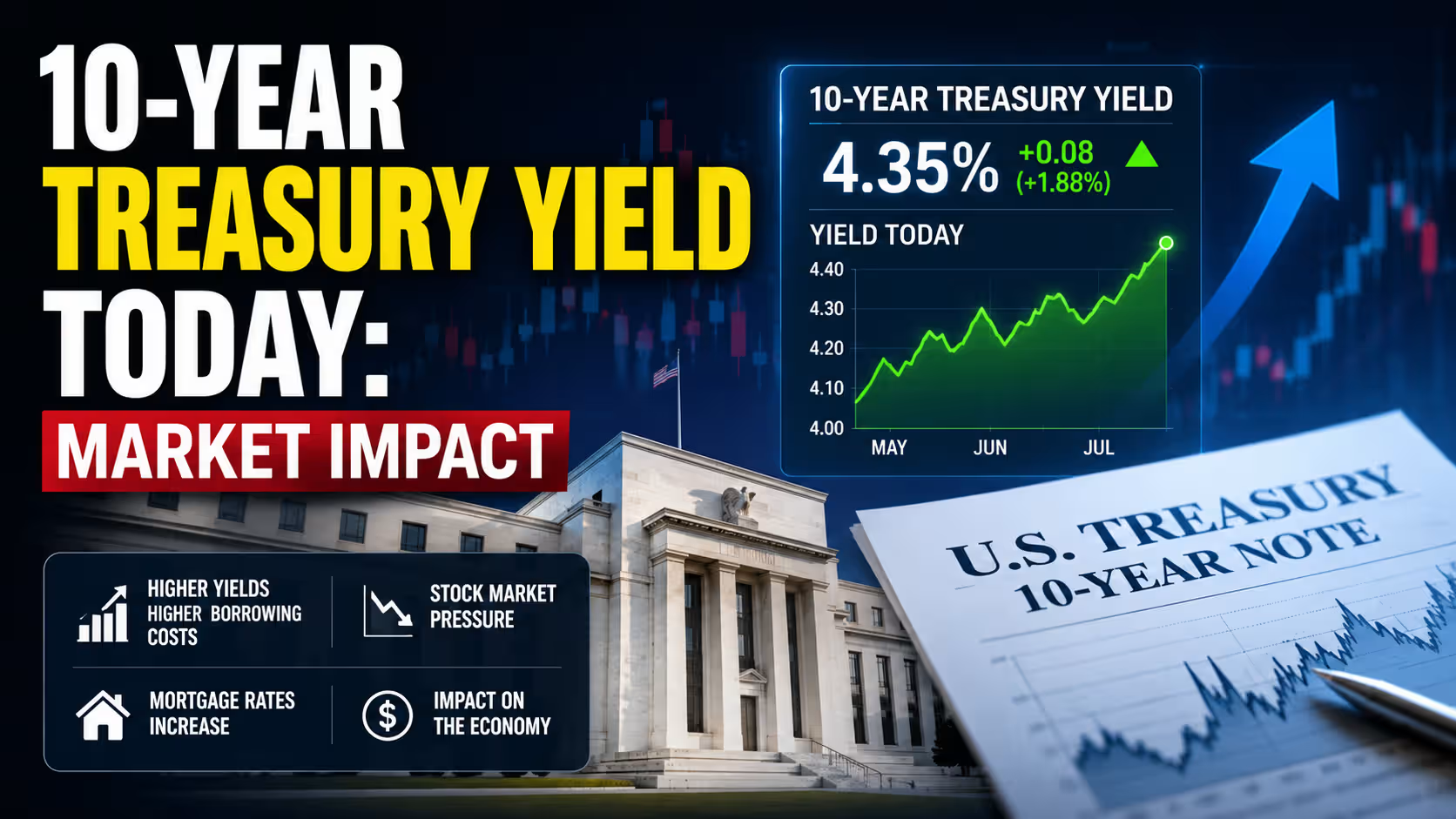
First, U.S. sovereign CDS spreads have risen sharply. The cost of insuring U.S. government debt spiked to its highest levels since the 2023 debt ceiling crisis, driven by concerns about U.S. fiscal policy, the unresolved debt limit, and growing federal deficits. In May 2025, 1-year spreads hit 52 basis points, up from 16 at the start of the year. Industry analysts widely agree this reflects political uncertainty and fiscal anxiety rather than a genuine belief that the U.S. will default — but the signal is real and worth watching.
Second, the private credit market is being drawn into the CDS ecosystem. Wall Street is introducing standardized CDS index products tied to the $2 trillion private credit market. Supporters say this adds liquidity and risk management tools to a previously illiquid market. Critics warn it could amplify losses if private credit stress occurs, echoing the warnings sounded about mortgage-backed CDS before 2008.
The Honest Assessment: Useful Tool or Systemic Risk?
Credit default swaps are genuinely useful. They help banks manage credit concentration, allow pension funds to protect bond portfolios, and give markets a real-time, money-backed signal of credit risk perception.
But they also carry systemic risks that regulators and policymakers continue to grapple with. The opacity of CDS markets — particularly single-name CDS on individual companies — still hinders complete regulatory oversight. The concentration of dealing activity in a few major banks creates potential single points of failure. And the temptation to use CDS for speculation rather than hedging remains a permanent structural tension in the market.
The European Systemic Risk Board’s 2025 analysis recommended new policy measures to boost transparency, strengthen oversight, and reduce over-reliance on CDS spreads as credit risk benchmarks. Those recommendations reflect a market that is better than it was in 2007, but not without risk.
Bottom Line: Why You Should Understand CDS Even If You Never Trade One
Credit default swaps move markets. When U.S. sovereign CDS spreads widen, bond yields often follow. When corporate CDS spreads surge, it can signal trouble ahead for equity markets and credit availability. Wider spreads are often a harbinger of reduced access to capital, rising unemployment, and declining corporate investment.
You do not need to trade CDS to benefit from understanding them. Watching CDS spreads on countries, major banks, and large corporations gives you an early-warning signal that rarely shows up in stock prices until it is too late. In a world where fiscal risks are real and credit markets are as active as ever, that edge matters.
A credit default swap (CDS) is essentially insurance on a loan or bond. The buyer pays a regular fee — called a spread — to the seller, and in return, the seller agrees to pay out a lump sum if the borrower (the reference entity) fails to repay their debt. For example, if you hold $10 million in corporate bonds and want to protect against default, you buy a CDS: you pay an annual fee to a bank, and if the company defaults, the bank pays you back the full $10 million minus any recovery value. The reference entity — the company or government whose debt is being insured — is not a party to the contract.
Credit default swaps were originated and first offered commercially in 1997 by JPMorgan. The instrument was developed as a way for banks to transfer credit risk off their balance sheets without selling the underlying loans. The CDS market grew steadily through the late 1990s and early 2000s, then exploded in size in the years leading up to the 2008 financial crisis, reaching a peak notional value of $61.2 trillion in 2007 — a number larger than global GDP at the time.
A CDS spread is the annual fee a protection buyer pays, expressed in basis points (one basis point = 0.01%). A spread of 100 basis points means the buyer pays 1% of the notional amount per year for protection. The higher the spread, the more the market believes the reference entity is at risk of defaulting. CDS spreads are watched closely by traders, economists, and policymakers as a real-time signal of credit risk. In May 2025, U.S. 1-year sovereign CDS spreads rose to 52 basis points — more than three times their level at the start of the year — reflecting market anxiety over the unresolved U.S. debt ceiling.
CDS did not cause the 2008 financial crisis — that was driven by falling real estate prices and highly leveraged financial institutions. But CDS dramatically amplified the damage. Institutions like AIG had sold massive amounts of CDS protection on mortgage-backed securities, collecting premiums for years. When housing prices collapsed, those securities plummeted in value, triggering a wave of credit events across thousands of CDS contracts. AIG alone had $440 billion in CDS exposure it could not pay, forcing a $180 billion U.S. government bailout. The overall CDS market’s notional value had peaked at $61.2 trillion — a level so large that when defaults hit, the payouts threatened to collapse the entire financial system.
A naked CDS is when an investor buys protection on a bond they do not actually own — purely as a speculative bet that the borrower will default. Unlike regular insurance (where you must have an insurable interest in what you’re insuring), CDS buyers are not required to hold the underlying debt. This means the total notional value of CDS contracts can far exceed the actual debt outstanding, allowing speculative positions to multiply. Naked sovereign CDS — speculative bets on government defaults — are now banned within the EU under the Short Selling Regulation, though they remain legal in the United States and most other markets.
Yes, significantly safer — but not without risk. Post-crisis reforms have introduced mandatory central clearing (reducing counterparty risk), standardized contract terms (improving pricing and transparency), mandatory trade reporting (giving regulators better oversight), and restrictions on naked sovereign CDS in the EU. The global CDS market has also shrunk dramatically from its $61.2 trillion peak in 2007 to around $9.4 trillion by end-2017. However, the European Systemic Risk Board’s 2025 analysis still found concerns around high market concentration among a few dealers, lack of full post-trade transparency for single-name CDS, and the potential systemic risks of introducing CDS products into the private credit market.
U.S. sovereign CDS spreads widened significantly in 2025, reaching their highest levels since the 2023 debt ceiling crisis. The main driver is anxiety about U.S. fiscal policy — specifically the unresolved debt ceiling debate, growing federal deficits, and political uncertainty. In May 2025, 1-year CDS spreads hit 52 basis points, up from just 16 at the start of the year. Analysts from Invesco, Barclays, and other major institutions emphasize that this reflects a ‘hedge against political risk, not insolvency’ — meaning most investors do not genuinely believe the U.S. will default, but they are paying to protect themselves in case political gridlock pushes the country toward a technical default, as nearly happened in 2023.