TSMC stock (NYSE: TSM) is dominating financial headlines this week after Taiwan Semiconductor Manufacturing Company posted record second-quarter 2026 results on July 16 — and then did something the market didn’t expect. Quick answer: TSMC reported Q2 revenue of $40.20 billion (up 36.0% year-over-year) and diluted earnings per ADR of $4.31 (up 77.4% YoY), comfortably beating Wall Street’s roughly $3.83 consensus estimate. Despite the blowout print, shares slipped about 4% as investors zeroed in on rising capital spending and margin questions tied to overseas fab expansion.
- AI demand is still accelerating — high-performance computing (AI/HPC) chips now make up roughly two-thirds of TSMC’s revenue.
- Capex is going up, not down — 2026 capital spending is tracking toward the top of TSMC’s $52–$56 billion range.
- Guidance came in strong — Q3 2026 revenue is guided at $44.6–$45.8 billion, ahead of Q2’s already-record print.
What Is TSMC and How Does It Work?
Taiwan Semiconductor Manufacturing Company is the world’s largest dedicated chip foundry, controlling an estimated 73% of the global foundry market according to Counterpoint Research. Unlike Intel or Samsung, TSMC doesn’t design its own chips — it manufactures them for “fabless” companies that do, including Nvidia, AMD, Broadcom, and Apple. That makes TSMC one of the most important — and most closely watched — companies in the entire AI supply chain.
TSMC’s business is built around advanced “process nodes,” essentially the size and efficiency of the transistors etched onto each chip. Smaller nodes (like 3-nanometer and the newer 2-nanometer “N2”) pack in more performance per watt, which is exactly what AI data centers need. TSMC also runs CoWoS advanced packaging lines, a bottleneck technology that bundles multiple chips together and is currently one of the tightest-supplied parts of the AI hardware stack.
Why Is TSMC Stock Making Headlines Right Now?
The short answer is Thursday’s Q2 2026 earnings release. According to TSMC’s official filing with the SEC, the quarter looked like this:
| Metric | Q2 2026 | YoY Change |
|---|---|---|
| Revenue | NT$1,270.38B (US$40.20B) | +36.0% (NT$) / +33.7% (US$) |
| Net Income | NT$706.56B | +77.4% |
| Diluted EPS | NT$27.25 (US$4.31/ADR) | +77.4% |
| Gross Margin | 67.7% | Above 65.5–67.5% guidance |
| Operating Margin | 60.3% | Above 56.5–58.5% guidance |
| Net Profit Margin | 55.6% | — |
Two nuances are worth flagging for anyone digging into the print. First, part of this quarter’s profit jump included a roughly $1.97 billion one-time gain from the sale and remeasurement of TSMC’s stake in Vanguard International Semiconductor, so the “clean” operating beat is slightly smaller than the headline net income number suggests, as TradingKey reported. Second, even with a beat-and-raise quarter, CNBC and other outlets noted TSM shares fell around 4% on the print, as investors weighed a heavier 2026 capital expenditure outlook — now tracking toward the top of the $52–$56 billion range — against near-term margin dilution from overseas fabs in Arizona and Japan.
Looking ahead, TSMC guided Q3 2026 revenue to $44.6–$45.8 billion with gross margin of 65–67%, implying the AI-driven growth cycle isn’t slowing down heading into the back half of the year.
TSMC’s results were driven by “strong demand for our leading-edge process technologies,” according to Wendell Huang, Senior Vice President and Chief Financial Officer of TSMC, in the company’s official Q2 2026 earnings release.
Fundamental Analysis and Market Potential
TSMC’s growth story is still, overwhelmingly, an AI story. High-performance computing chips — the category that includes AI accelerators — now account for roughly two-thirds of total revenue, and advanced nodes (7nm and smaller) made up 77% of wafer revenue in Q2. CoWoS packaging capacity is reportedly sold out through the end of 2026, and TSMC is ramping its 2-nanometer N2 node at a reported price premium over 3nm, which should support margins even as overseas expansion adds cost.
On the sell side, sentiment has stayed largely constructive — CNN/TipRanks data shows BofA recently raised its TSMC (TWSE: 2330) price target to NT$3,100 from NT$3,060 ahead of the print. That said, customer concentration is a real factor to watch: TSMC’s largest customers (Nvidia, AMD, Apple, Broadcom) drive an outsized share of advanced-node revenue, and reports of hyperscalers exploring custom in-house AI silicon are a long-term variable for foundry demand.
PayPal Stock News Today: Price, Takeover Bid, and What It Means (July 2026)
Historical Price Performance
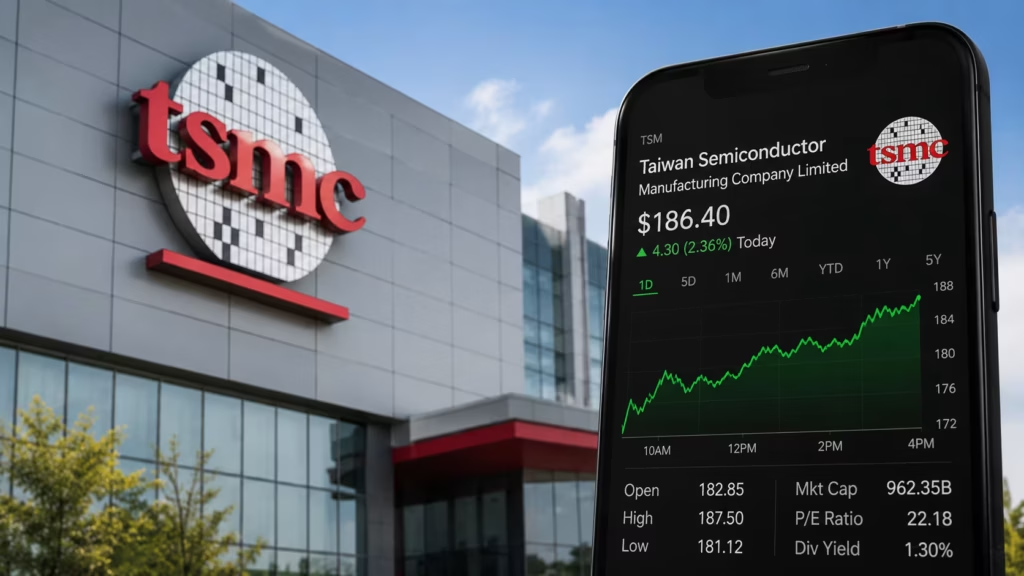
Heading into the Q2 print, TSM traded around $426.62, up roughly 52% year-to-date, but about 10% off its July high of $474.71. TSMC’s market capitalization stands at approximately $2.2 trillion, based on publicly traded ADR shares, making it one of the largest companies in the world by market value and a bellwether for the entire semiconductor sector.
Key Risks and Volatility Factors
- Capex and margin dilution: Overseas fabs in Arizona and Japan cost more to run than TSMC’s Taiwan facilities, which can pressure margins even as revenue grows.
- Valuation expectations: With the stock already up sharply this year, the market has priced in a lot of good news — any slowdown in AI capex from hyperscalers could hit the stock hard.
- Customer concentration: A small group of AI/chip customers drives an outsized share of advanced-node revenue.
- Geopolitical risk: TSMC’s core manufacturing base in Taiwan remains exposed to regional geopolitical tension and export-control policy shifts.
- Competitive pressure: Coverage this week flagged a potential new lower-cost rival looking to undercut TSMC — a reminder that while TSMC’s lead is large today, it isn’t permanent.
TSM Stock Price Chart
For a live, interactive view of TSM’s price action, you can embed a real-time chart widget directly in this post. Paste the snippet below into a WordPress “Custom HTML” block:
What is TSMC’s stock ticker and where does it trade?
TSMC trades on the New York Stock Exchange under the ticker TSM (as an ADR) and on the Taiwan Stock Exchange under 2330.
Why did TSMC stock fall after posting record Q2 2026 earnings?
Even though TSMC beat consensus on revenue and EPS, shares fell about 4% as investors focused on a heavier 2026 capital expenditure outlook and margin pressure from overseas fab expansion in Arizona and Japan.
What is TSMC’s guidance for Q3 2026?
TSMC guided Q3 2026 revenue of $44.6 to $45.8 billion, with gross margin expected between 65% and 67%, driven by continued AI chip demand and the ramp of its 2-nanometer N2 node.
What is TSMC’s market cap in 2026?
As of mid-July 2026, TSMC’s market capitalization is approximately $2.2 trillion, based on publicly traded ADR shares, making it one of the largest semiconductor companies in the world.
Is TSMC stock a good investment right now?
TSMC shows strong fundamentals, record earnings, and heavy exposure to AI chip demand, but the stock has already rallied sharply in 2026 and carries capex, margin, and geopolitical risks. Whether it fits your portfolio depends on your own goals, risk tolerance, and time horizon, so it’s worth consulting a licensed financial advisor before deciding.
Disclaimer: The information provided in this article is for educational and informational purposes only and does not constitute financial, investment, or trading advice. Stocks are highly volatile, and past performance is not indicative of future results. Always do your own research (DYOR) and consult with a licensed financial advisor before making any investment decisions.