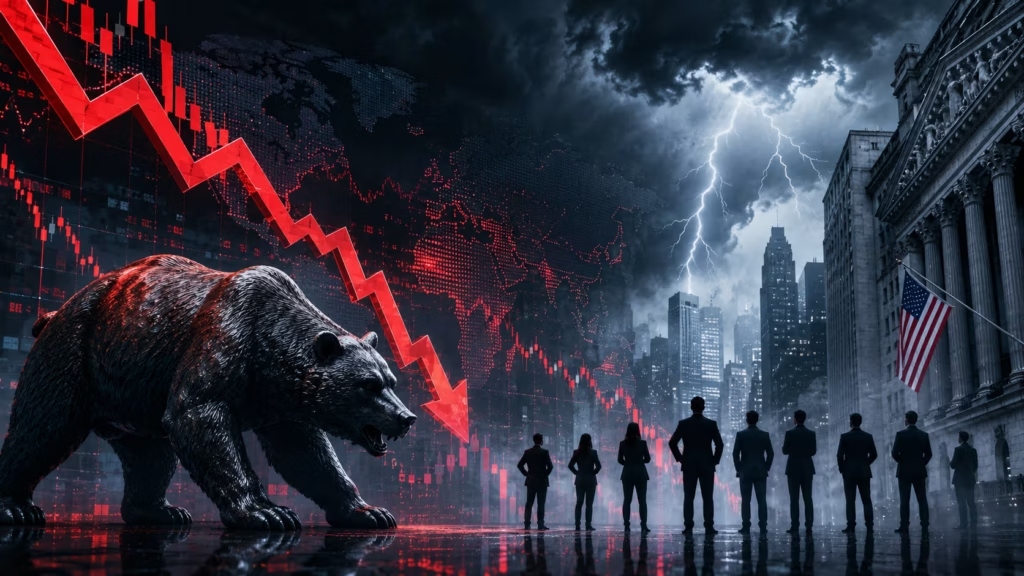
Stock market crash fears return as global investors watch inflation with growing concern in May 2026. Oil prices have surged over 60% since February, the Federal Reserve is holding rates steady, and Wall Street just recorded its most nervous trading week in months. Everyday investors are asking a simple but important question: Is a crash coming?
This article breaks down everything you need to know, from the latest market data to expert predictions, in plain, simple language.
Why Are Stock Market Crash Fears Back in 2026?
The fear did not come out of nowhere. Several things happened at the same time, and together they spooked markets around the world.
On February 28, 2026, U.S. military forces began operations against Iran. Iran responded by closing the Strait of Hormuz, a critical shipping lane that handles roughly 20% of all global oil exports. Almost overnight, oil prices shot up from about $67 per barrel to over $111 per barrel — a 66% rise in just days.
Higher oil prices push up the cost of almost everything: fuel, food, transportation, and manufacturing. That means inflation stays high for longer, and the Federal Reserve has less room to cut interest rates.
On May 15, 2026, the Dow Jones fell sharply, and the Nasdaq and S&P 500 also dropped, as investors reacted to rising oil prices, renewed inflation fears, and fresh geopolitical tensions after President Trump took a harder stance on Iran following his summit with China’s President Xi Jinping.
What Is Inflation Doing to the Stock Market Right Now?
Inflation is the main reason markets are on edge today.
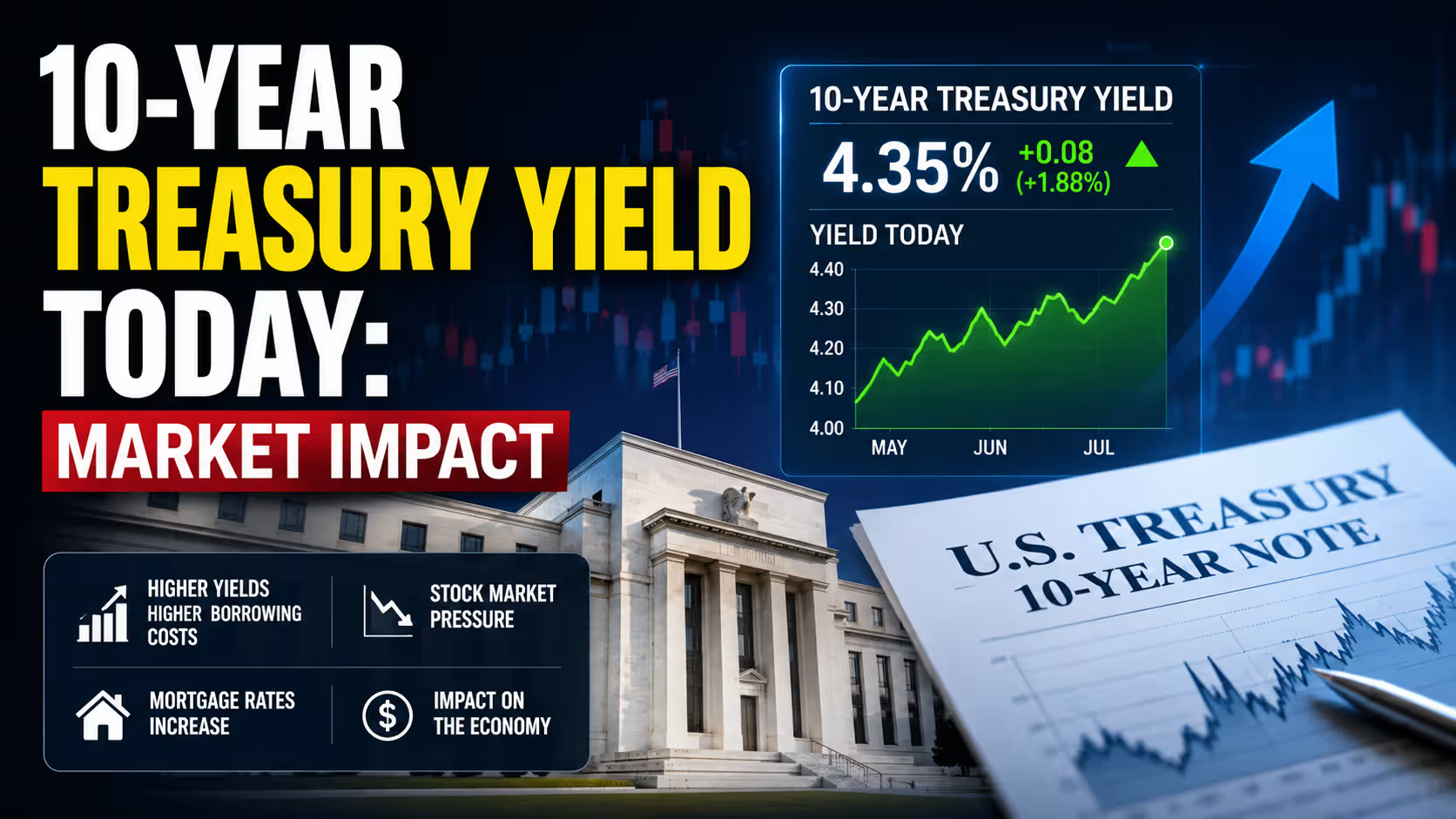
The Fed held interest rates steady at 3.50%–3.75% at its April 28–29 meeting. The central bank wants to see clear proof that inflation is falling before it cuts rates. But that proof has been hard to find.
Goldman Sachs now expects PCE inflation — the Fed’s favourite measure — to stay close to 3% through the rest of 2026. That is a full percentage point above the Fed’s 2% target. Goldman has also pushed back its rate-cut forecast to December 2026 at the earliest, with the next cut potentially coming in March 2027.
JPMorgan is even more cautious. Its analysts expect the Fed to hold rates steady all through 2026. In fact, JPMorgan sees the next Fed move as a possible rate hike of 25 basis points in the third quarter of 2027.
Barclays went further, dropping its forecast for any 2026 cut entirely. It now expects the first cut to arrive in March 2027.
JPMorgan CEO Jamie Dimon made his concerns very public at a conference in Oslo on April 28, 2026. He warned that inflation has many drivers still at work, including the Iran war, the global push to rebuild military spending, massive infrastructure investment needs, and rising government deficits.
Why the US Dollar Index Is Crashing and Gold Prices Are Rising
Latest Analysis: How Overvalued Is the Market Today?
This is where the picture gets even more worrying for cautious investors.
As of May 6, 2026, the S&P 500’s Shiller Price-to-Earnings (P/E) Ratio stood at 41.83. The long-run historical average for this ratio is just 17.36. The only time the reading has been higher was right before the dot-com bubble burst, when it hit 44.19.
The Buffett Indicator — which compares total stock market value to the size of the economy — sits at 217% to 228% of U.S. GDP. During the dot-com peak, it reached 150%. Today’s reading is far beyond that.
The top 10 companies in the S&P 500 now make up more than 35% of the entire index’s weight. That kind of concentration means that if just a handful of big technology stocks stumble, the whole market feels the pain.
The New York Fed’s recession probability model currently sits at around 20.7%. That does not mean a recession is certain, but it does mean the risk is real and rising.
What Are Global Investors Watching Most Closely?
Right now, global investors are keeping a close eye on three things.
Oil Prices and the Middle East The Strait of Hormuz handles around 20% of the world’s crude oil. As long as the conflict with Iran keeps that route disrupted, energy prices stay elevated and inflation stays sticky. Barclays warned that a prolonged blockage could knock out 13 to 14 million barrels of oil per day from global supply.
Federal Reserve Policy Markets had hoped the Fed would cut rates at least twice in 2026. Those hopes have faded fast. With inflation still running above target and energy costs rising, the Fed is in a very difficult spot. A rate hike — once unthinkable for this year — is now part of the conversation at JPMorgan.
AI and Big Tech Valuations A big part of the 2025–2026 market rally came from excitement around artificial intelligence. Big Tech companies plan to spend roughly $300 billion on AI infrastructure in 2025 alone, with projections reaching $1.6 trillion through 2029. Investors are starting to question whether the returns from all that spending will arrive quickly enough to justify today’s stock prices.
Stock Market Crash Prediction: What Experts Are Saying
No analyst is saying a crash is guaranteed. But several are using words like “significant risk,” “overvalued,” and “historically stretched.”
Goldman Sachs has maintained its S&P 500 target of 7,600 for 2026, but the index has struggled to make clear progress with all the headwinds in play.
Motley Fool analysis from earlier in 2026 noted that history gives mixed signals. After the strong gains of 2025, a modest decline in 2026 looks like the most likely outcome — but sharper drops are possible.
U.S. Bank’s senior investment strategist Rob Haworth pointed out that solid corporate earnings growth is still supporting stock prices, even in a higher-rate environment. He noted that sectors with strong pricing power — such as energy, utilities, industrials, and materials — are performing better than the broader market this year.
The most important thing most experts agree on: investors who panic and sell during downturns often miss the recovery. History shows that the best single-day gains in the market frequently happen within weeks of the worst single-day losses.
How Should Everyday Investors Respond Today?
You do not need to be a professional trader to make smart decisions right now. Here are some straightforward steps worth considering.
Stay calm and stay informed. Selling in a panic locks in losses and forces you to make two perfect decisions: when to exit and when to get back in. Most investors who try this end up worse off.
Diversify across sectors. In 2026, energy, utilities, industrials, and healthcare have shown stronger performance than the narrow AI and mega-cap tech names that led markets in 2024 and 2025. Spreading your money across sectors reduces your risk.
Think long-term. If your investing horizon is 10 years or more, staying the course through volatility has historically produced positive results in every 20-year period for the S&P 500.
Avoid over-leveraging right now. With CPI data, geopolitical summits, and Fed commentary coming in week after week, this is not a moment to take on extra risk with borrowed money.
Consult a financial advisor. Every investor’s situation is different. A licensed financial advisor can help you make decisions that match your own goals, risk tolerance, and timeline.
The main causes are the Iran conflict, which shut down the Strait of Hormuz and pushed oil prices up by over 60%, sticky inflation running near 3%, the Federal Reserve holding interest rates steady, and extremely high stock market valuations.
No analyst is guaranteeing a crash, but risks are elevated. Goldman Sachs, JPMorgan, and Barclays all expect the Fed to hold or even raise rates, which puts pressure on stocks. Valuations are historically high, and a market decline is more likely than a melt-up based on current data.
The Federal Reserve held interest rates at 3.50%–3.75% at its April 28–29, 2026 meeting. It is waiting for clear evidence that inflation is dropping before it cuts rates. Inflation is running close to 3%, well above the Fed’s 2% target, and rate cuts now look unlikely until late 2026 or early 2027.
High inflation forces the Fed to keep interest rates elevated. Higher rates increase borrowing costs for companies, reduce consumer spending, make bonds more attractive versus stocks, and compress the valuations investors are willing to pay for future earnings. All of these factors put downward pressure on stock prices.
By historical standards, yes. As of May 6, 2026, the S&P 500’s Shiller P/E ratio was 41.83, far above the long-run average of 17.36. The only time this measure was higher was just before the dot-com crash in the early 2000s. The Buffett Indicator also sits at 217–228% of GDP, well above historical warning levels.
Stay calm and avoid panic selling. Diversify across sectors, including energy, utilities, and industrials, which are performing better in the current environment. Think long term. If you do not need the money for 10 or more years, history shows that staying invested through downturns produces better results than trying to time the market. Always speak with a licensed financial advisor for personal guidance.
Goldman Sachs maintains an S&P 500 target of 7,600, but progress has been slow. JPMorgan sees no rate cuts in 2026 and a possible hike in 2027. Barclays expects the first rate cut only in March 2027. Most analysts expect 2026 to be more challenging than 2025, with a modest market decline more likely than a strong rally, though a full crash remains unlikely unless oil prices or inflation spiral sharply higher.