Dow Jones Forecast: What Could Happen in the Next Trading Session

The Dow Jones forecast heading into the next trading session on Monday, May 19, 2026, looks cautious at best. After a rough Friday that wiped out 537 points and dragged the index back below 50,000, investors are walking into a new week with a lot on their minds. Rising oil prices, a hotter-than-expected inflation report, a brand-new Federal Reserve chairman, and growing geopolitical tension around the Iran conflict are all shaping how the market could open and where it could go. If you want to understand what is happening and what to watch for, this analysis breaks it all down clearly.
What Happened in the Latest Session
Friday, May 15, 2026 ended with a broad market sell-off. The Dow Jones Industrial Average dropped 537.29 points, or 1.07%, to settle at 49,526.17. The S&P 500 fell 1.24% to close at 7,408.50, and the Nasdaq Composite lost 1.54%, finishing at 26,225.14.
Just one day earlier, on Thursday, the Dow had crossed above 50,000 for the first time in weeks, and the S&P 500 cleared 7,500. That rally was short-lived.
Friday’s sell-off hit technology stocks hardest. Nvidia dropped 4.4%, Intel fell more than 6%, Advanced Micro Devices lost 5.7%, and Micron Technology shed 6.6%. The one bright spot on the Dow was Microsoft, which climbed roughly 3% after investor Bill Ackman revealed that his firm, Pershing Square, had built a significant position in the stock. Boeing was among the biggest losers, falling 3.74%, partly on disappointment over Chinese airline orders coming in below expectations.
Dow Jones Forecast: The 5 Key Factors to Watch Next Session
1. Oil Prices and the Iran Conflict
Energy prices are right at the center of the current market stress. West Texas Intermediate crude oil jumped more than 2% on Friday to trade above $103 per barrel, while international benchmark Brent crude surpassed $108 per barrel. Gas prices have held around $4.53 per gallon nationally.
The surge in oil is directly tied to the ongoing conflict with Iran. Strait of Hormuz shipping traffic has fallen sharply, with only a handful of ships passing through per day compared to a daily average of roughly 120 vessels just three months ago. That choke on global oil supply is pushing energy prices higher — and that pushes inflation higher with it.
Dan Niles, founder of Niles Investment Management, warned on CNBC Friday that this dynamic is becoming uncomfortable. He pointed out that 10 of the last 12 U.S. recessions were preceded by a spike in oil prices. Investors will be watching closely for any diplomatic developments over the weekend that could cool or escalate the conflict.
2. Inflation Data Is Running Hot
The April consumer price index report released this week showed inflation rising 3.8% annually — the highest reading since May 2023. Economists had expected 3.7%. Excluding food and energy, core inflation came in at 2.8% annually.
This was not a one-week blip. A combination of rising gasoline prices, food costs, and electricity bills drove the upward surprise. Tomato prices alone surged 15% month-over-month for a second straight month, driven by drought conditions across much of North America.
As Edward Jones economists note, inflation is expected to peak somewhere between 3.5% and 4% in the second quarter of 2026 before starting to ease later in the year. But two hot inflation readings in a single week have rattled investor confidence and put rate cut expectations firmly on hold.
3. A New Federal Reserve Chairman Takes the Wheel
Friday also marked the end of Jerome Powell’s tenure as Federal Reserve chairman. Kevin Warsh officially takes over as the new Fed Chair. Markets tend to dislike uncertainty at the central bank, and this transition is happening at a difficult moment.
Warsh has previously signaled a preference for lower rates, but two ugly inflation prints this week put him in a tough spot immediately. As Collin Martin, head of fixed income research at the Schwab Center for Financial Research, put it: “It will be very difficult for him to argue for lower rates when inflation has reaccelerated.”
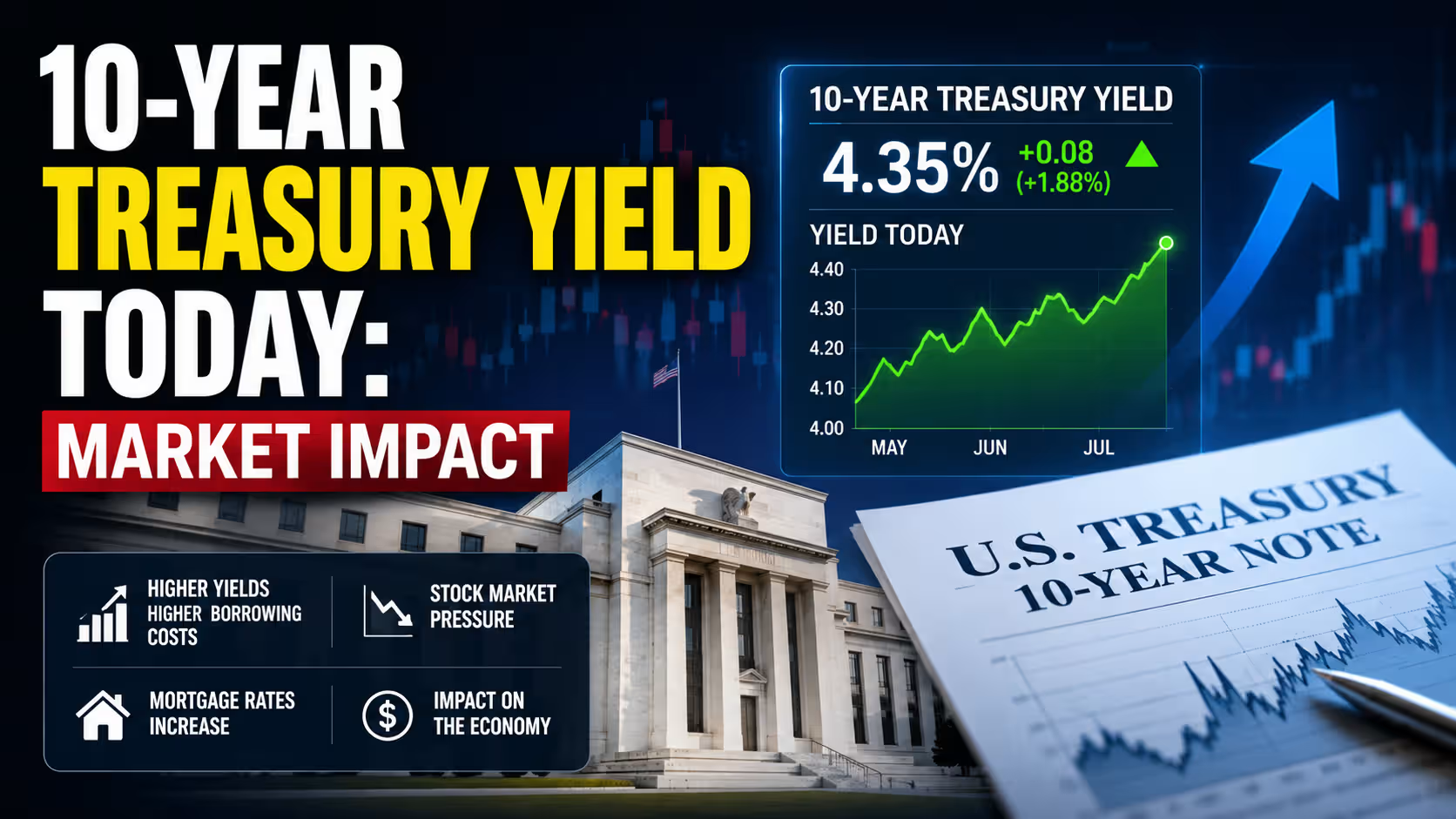
The 10-year Treasury note yield spiked nine basis points on Friday to 4.55% — the highest level in a year. The 30-year bond yield topped 5.1%, levels not seen since May 2025. Higher yields put downward pressure on growth and technology stocks because they make borrowing more expensive and reduce the current value of future earnings.
4. Fed Rate Hike Probability Is Rising Fast
One month ago, the probability of a Federal Reserve rate hike in 2026 sat at just 1%. Today, that number has surged. According to the CME FedWatch Tool, a rate hike by December 2026 now carries nearly 51% probability. A hike by January 2027 has roughly 60% probability, and a hike by March 2027 is priced in at better than 71%.
In other words, the market has completely reversed its expectations. Just weeks ago, investors were betting on rate cuts. Now, they are pricing in rate hikes.
This is a major shift that could continue to weigh on the Dow Jones in the sessions ahead. The Cboe Volatility Index (VIX) already topped 19 on Friday, approaching the key 20-level that signals heightened market stress.
5. Retail Sector Earnings Week Is Coming
The upcoming trading week brings important earnings from the retail sector. Lowe’s reports first-quarter 2026 results on Wednesday, May 20, before the opening bell. Citi upgraded Lowe’s to a buy rating ahead of the print, setting a $285 price target and expecting the home improvement chain to beat street estimates.
The broader retail picture is not as rosy. The SPDR S&P Retail ETF fell more than 6% in the prior week, putting it on track for its fourth straight weekly decline and its worst weekly performance since October 2025. Names like Kohl’s, Sally Beauty, and Advance Auto Parts all fell sharply during the week. Investors will be watching closely to see if consumer spending is showing signs of strain from higher gas prices and sticky inflation.
What the Technical Picture Says
The Dow’s drop back below 50,000 on Friday is a notable technical development. The index was unable to hold that psychologically important level after briefly reclaiming it on Thursday. Support now sits near the 49,200 to 49,500 range, which aligns with recent consolidation levels.
If oil prices escalate over the weekend or additional hawkish comments emerge from the new Fed leadership, the Dow could test the lower end of that support zone early Monday. A meaningful rebound would likely require either a pullback in oil prices or a reassuring statement from the Fed.
The VIX approaching 20 adds to the caution. Historically, when volatility climbs toward and above that level, short-term price swings increase significantly in both directions.
What Analysts Are Saying Today
Multiple analysts flagged Friday’s sell-off as a warning sign, not just a one-day event.
Adam Crisafulli of Vital Knowledge noted that the technology group has seen an “extremely unsustainable move in recent weeks” and remains vulnerable to further profit-taking regardless of headlines.
Thomas Martin of Globalt Investments warned that inflation is “going to keep on building” as long as the Iran conflict continues pushing energy prices higher, and that higher gas and food costs will “crimp more and more people” over time.
On the more constructive side, the Empire State Manufacturing Index jumped to 19.6 in May from 11.0 in April — the highest reading since April 2022 and well above the 7.0 estimate. That kind of manufacturing strength suggests the broader U.S. economy still has real momentum underneath the market turbulence.
Prediction: Bull Market or Speed Bump?
Most long-term strategists still believe the broader bull market remains intact. The AI investment cycle is real, earnings growth across sectors remains solid, and labor market conditions have improved with back-to-back monthly payroll gains averaging roughly 90,000 private-sector jobs per month so far in 2026.
Long-term forecasts remain broadly optimistic. One forecast model projects the Dow Jones could trade in the range of 54,605 by the end of May, with further gains to approximately 55,679 by end of June and 58,178 by end of July — assuming the macro headwinds ease and earnings hold up.
But the near-term path for the Dow in the next trading session is clouded. Oil above $100, yields approaching multi-year highs, a brand-new Fed chair, and a market that just took its biggest single-day tech selloff in weeks — these are not conditions that typically produce clean Monday morning rallies.
What Investors Should Do Right Now
Do not panic. Single-day or single-week moves, however sharp, do not define long-term investment outcomes. The Dow recovered from a 33% decline in early 2025 to finish that year well into positive territory.
Watch oil prices closely. The single biggest variable for the next trading session is what happens with crude oil. A de-escalation in the Iran conflict over the weekend could reverse Friday’s losses quickly.
Keep an eye on Treasury yields. If the 10-year yield moves above 4.6% or the 30-year stays above 5.1%, expect continued pressure on tech stocks and growth names.
Stay diversified. High concentration in a few mega-cap tech names adds risk right now. Friday showed that even market darlings like Nvidia and AMD can shed significant value in a single session.
Know what earnings are coming. Lowe’s on May 20 is the marquee retail print of the week. Other retail names could set the tone for how the market reads consumer health through the rest of May.
Heading into Monday, May 19, 2026, the Dow Jones forecast is cautious. The index closed at 49,526.17 on Friday, down 537.29 points or 1.07%, after failing to hold the 50,000 level. Key risks include rising oil prices above $103 per barrel, a hot inflation reading of 3.8% annually, climbing Treasury yields, and uncertainty around the new Federal Reserve chair Kevin Warsh. A sustained recovery would likely require oil prices to ease and no further hawkish signals from the Fed.
The Dow fell 537.29 points on May 15, 2026, because of a combination of factors: a hotter-than-expected April inflation report (3.8% annual CPI), surging oil prices tied to the Iran conflict, rising Treasury yields, and heavy profit-taking in technology stocks. Investors also reacted nervously to the transition at the Federal Reserve, as Jerome Powell handed over the chairmanship to Kevin Warsh.
As of May 2026, the probability of a Federal Reserve rate hike has risen sharply. According to the CME FedWatch Tool, a rate hike by December 2026 now carries nearly 51% probability, up from just 1% a month ago. Two hot inflation reports in one week and surging oil prices have dramatically changed market expectations, shifting from rate cuts being priced in to rate hikes now being on the table.
Rising oil prices hurt the Dow Jones in two key ways. First, they push inflation higher, which reduces the chance of Federal Reserve rate cuts and increases the likelihood of rate hikes. Second, higher energy costs squeeze consumer spending and corporate profit margins, especially for industrials and transportation companies. With WTI crude above $103 per barrel in May 2026, oil is one of the single biggest risks to the current Dow Jones outlook.
In the latest trading session on May 15, 2026, Boeing (-3.74%), Caterpillar (-3.42%), and Nvidia (-4.39%) were the biggest drags on the Dow Jones. Microsoft was the standout gainer, rising roughly 3% after Bill Ackman’s Pershing Square disclosed a new stake in the company. Technology stocks broadly weighed on the index as investors locked in profits after several weeks of sharp gains in AI-related names.
Most long-term analysts still believe the broader bull market remains intact in 2026. Corporate earnings are solid, private-sector job gains have averaged roughly 90,000 per month so far this year, and AI-driven investment continues to support the technology sector. However, rising oil prices, sticky inflation, and growing rate hike expectations have introduced significant short-term risk. Long-term forecasts suggest the Dow could reach the 54,000 to 55,000 range by mid-2026 if macro conditions stabilize.
For the week of May 19, 2026, investors should keep a close eye on Lowe’s first-quarter earnings report on May 20, which will give clues about consumer health and spending. Beyond that, any updates from the Federal Reserve under new Chair Kevin Warsh, developments in the Iran oil conflict, and Treasury yield movements will be critical. Any data that suggests oil-driven inflation is easing could give the Dow a meaningful boost in the coming sessions.