Why Global Traders Are Watching Oil Prices Closely Today
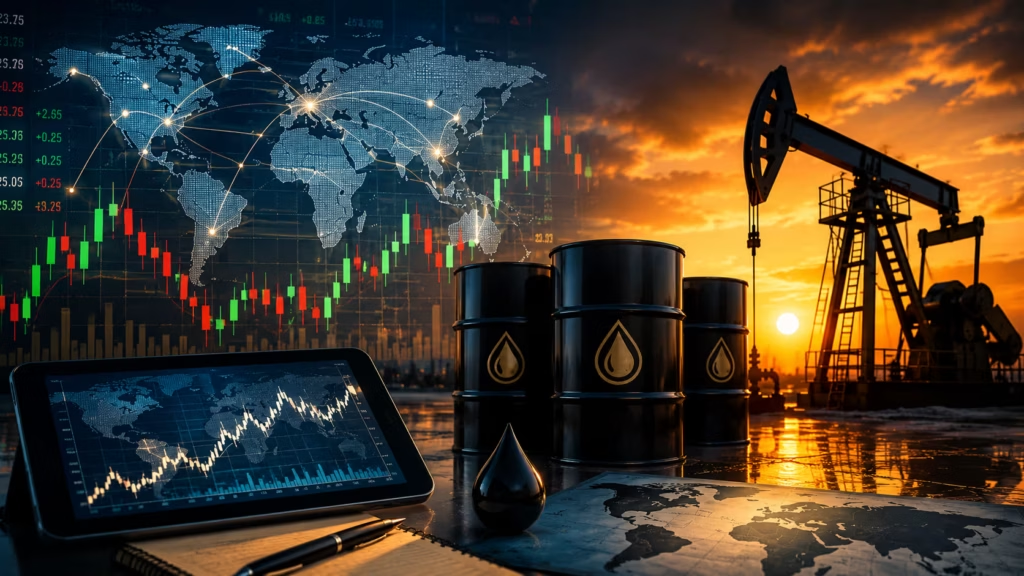
Global traders are watching oil prices closely today — and for very good reason. Brent crude oil was trading at around $110.87 per barrel on May 13, 2026, while WTI futures held above $101 per barrel on May 15. These are some of the highest prices the world has seen in years, and the situation behind them is anything but simple.
At the heart of it all is a major crisis at the Strait of Hormuz — the narrow stretch of water through which around 20% of the world’s entire oil supply passes. When that route gets blocked, every trader, government, airline, and factory on the planet feels it.
Here is a clear, honest look at what is happening, why oil prices are moving so sharply, and what it means for everyday people and the global economy.
What Sparked Today’s Oil Price Surge
On February 28, 2026, the United States and Israel launched joint air strikes on Iran. The conflict immediately triggered one of the most serious energy crises in modern history.
Iran responded by effectively closing the Strait of Hormuz to tanker traffic. Major global shipping companies — including Maersk, CMA CGM, and Hapag-Lloyd — quickly suspended routes through the strait. Oil tankers were struck near the passage, and outgoing traffic ground to a near halt.
The International Energy Agency (IEA) called this the largest supply disruption in the history of the global oil market. That is not an exaggeration. In March 2026 alone, global oil supply fell by more than 10 million barrels per day — an almost unimaginable drop.
The Strait of Hormuz: Why One Narrow Waterway Shakes the World
The Strait of Hormuz is only about 33 kilometres wide at its narrowest point, but it carries enormous weight for the global economy.
According to the U.S. Energy Information Administration, around 20 million barrels of oil and petroleum products moved through this passage every single day in 2024 — equal to roughly 20% of all global petroleum consumption.
When that route gets blocked, there is no quick alternative. The IEA estimates that only 3.5 to 5.5 million barrels per day can be rerouted through pipelines that bypass Hormuz. That leaves a daily shortfall of 14 to 16 million barrels — a gap no other region in the world can fill quickly.
The UAE, Saudi Arabia, Kuwait, Iraq, Qatar, and Bahrain collectively shut in over 10.5 million barrels per day of production in April alone, simply because they had no way to export it.
Even Saudi Arabia’s oil output dropped to its lowest level since 1990.
How High Have Oil Prices Gone? Latest Analysis
Oil markets have been extremely volatile since late February. Here is a quick timeline of what happened:
Early March: Brent crude surged 10–13%, crossing $80–82 per barrel within days of the conflict starting.
March 8: Brent crossed $100 per barrel for the first time in four years.
Peak: Brent crude hit a high of $126 per barrel at its worst point in March, and even reached $138 per barrel briefly in April.
April average: Brent crude averaged $117 per barrel for the entire month of April 2026, according to the U.S. Energy Information Administration.
Today (May 15, 2026): Brent is trading around $110 per barrel, with WTI holding above $101 per barrel.
The largest ever monthly increase in oil prices was recorded in March 2026 — a historic milestone that shows just how severe this crisis has become.
Why Global Traders Are Watching Oil Prices Closely Today: The Live Situation
Right now, traders are focused on several key developments unfolding in real time.
The Trump-Xi Meeting
U.S. President Donald Trump and Chinese President Xi Jinping recently held talks, with both leaders discussing the Strait of Hormuz. The White House confirmed that Xi expressed interest in increasing purchases of U.S. crude oil. U.S. Secretary of State Marco Rubio has urged China to use its influence on Iran to push for the strait to reopen.
This is significant because China receives roughly a third of its oil through the Strait of Hormuz. Any diplomatic breakthrough involving China could shift oil prices dramatically.
Iran Allowing Some Ships Through
Reports have emerged that Iran has begun allowing transit for some Chinese ships. Around 30 vessels reportedly crossed the Strait of Hormuz in recent hours. Traders are watching this closely because even a partial reopening could ease supply pressure and bring prices down.
OPEC’s Latest Update
OPEC cut its demand growth estimate for 2026 to about 1.2 million barrels per day, down from 1.4 million bpd in its previous forecast. The cartel’s production fell by 1.7 million barrels per day in April — a decline of more than 30% since the start of the conflict.
The UAE also formally left OPEC on May 1, 2026, reducing the group’s spare production capacity significantly going forward.
Strategic Reserve Release
In March, the IEA took the extraordinary step of releasing 400 million barrels of oil from emergency reserves — the largest coordinated release in the agency’s history. But analysts warn that reserves are not a long-term fix. The IEA itself has said the global oil market is likely to remain significantly undersupplied until at least October 2026, even if the conflict ends next month.
What This Means Beyond Oil Prices
The oil price spike is not just a problem for drivers at the pump. It has wide-reaching effects across the entire global economy.
Food Prices and Fertilizers
The Arabian Gulf accounts for at least 20% of all global seaborne fertilizer exports. Around 46% of all globally traded urea — the world’s most widely used nitrogen fertilizer — comes from the region. With those exports disrupted, food production costs are rising worldwide, particularly for major agricultural economies like India, Brazil, and China.
Inflation and Recession Risk
Analysts have warned that if the disruption continues, it could add 0.8% to global inflation. The Dallas Federal Reserve estimates that global real GDP growth in 2026 could fall by 0.2 to 0.3 percentage points if disruptions last one to two quarters — and by as much as 1.3 percentage points if the crisis stretches on for three quarters.
UNCTAD has also warned that developing economies will feel the pain most sharply, as rising energy and food costs strain public finances and household budgets in countries that can least afford it.
Airlines, Plastics, and More
Airlines across the Middle East and Asia have faced widespread cancellations due to jet fuel shortages. Shipping companies are rerouting vessels around Africa’s Cape of Good Hope, adding weeks to transit times and pushing freight costs higher. About 85% of polyethylene exports from the Middle East normally pass through Hormuz. That means prices for packaging, car parts, and consumer goods are rising too.
Oil Price Prediction: What Experts Are Saying
Predictions vary depending on how the conflict develops. Here is where major institutions stand:
J.P. Morgan had forecast Brent averaging around $60 per barrel in 2026 before the conflict, based on soft supply-demand fundamentals. The crisis has blown well past that estimate.
EIA (U.S. Energy Information Administration) assumes the Strait of Hormuz will remain effectively closed until late May, with shipping traffic starting to pick up in June. Under that scenario, global oil inventories will decrease by 2.6 million barrels per day this year.
Goldman Sachs and Barclays have highlighted the risk of sustained high oil prices if the strait stays restricted for a longer period.
Some traders and analysts are already discussing the possibility of oil hitting $200 per barrel if the strait stays closed and no diplomatic deal is reached.
The IEA has warned that the market will remain undersupplied until at least October 2026, even under relatively optimistic scenarios.
What Would Bring Oil Prices Down?
Traders are watching for any of these developments that could ease prices:
A diplomatic agreement that reopens the Strait of Hormuz to normal tanker traffic. Increased purchases of U.S. crude by China, which would help balance global supply flows. A faster-than-expected restart of shut-in wells in Gulf countries. More non-OPEC production from the U.S., Brazil, and other producers stepping up output.
Even if the strait reopens, analysts warn that oil supply from the Middle East will take months to recover. Some wells may have been permanently damaged during hasty shutdowns. Others will need maintenance and new drilling before production resumes.
The world’s biggest independent oil trader, Vitol, said it plainly: “Today, all of the spare capacity is behind the Strait of Hormuz.”
The Bottom Line
Oil has always been one of the most closely watched commodities in the world. But right now, it sits at the intersection of a major war, a historic supply shock, and a high-stakes diplomatic standoff between the world’s biggest powers.
Global traders are watching oil prices closely today because what happens in the Strait of Hormuz over the coming weeks will shape inflation, economic growth, food prices, and geopolitics for years to come.
Whether you fill a car, pay for groceries, run a business, or manage an investment portfolio, the price of oil today is a number that touches your life directly.
Global traders are watching oil prices closely today because the Strait of Hormuz crisis — triggered by the U.S.-Israel conflict with Iran starting February 28, 2026 — has disrupted around 20% of the world’s daily oil supply. This has pushed Brent crude above $110 per barrel and created the largest oil supply disruption in history, according to the IEA.
As of May 13–15, 2026, Brent crude oil is trading at around $110–111 per barrel, while WTI (West Texas Intermediate) futures are holding above $101 per barrel. Prices peaked as high as $138 per barrel in April 2026 before easing slightly.
The Strait of Hormuz is one of the world’s most critical energy chokepoints. Around 20 million barrels of oil and petroleum products pass through it every day — roughly 20% of global petroleum consumption. When it is blocked, there are very few alternative routes, which immediately creates a global oil supply shortage and drives prices higher.
Some traders and analysts are discussing scenarios where Brent crude could reach $200 per barrel if the Strait of Hormuz stays closed for an extended period and no diplomatic deal is reached. The IEA says the global oil market is likely to remain significantly undersupplied until at least October 2026.
Rising oil prices push up fuel costs at the pump, raise airline ticket prices, increase the cost of shipping goods, and make food more expensive because fertilizers and farm energy costs go up. Economists warn the current crisis could add 0.8% to global inflation and slow economic growth worldwide.
OPEC’s production fell by 1.7 million barrels per day in April 2026 — a decline of over 30% since the conflict began — mainly because producers in the Gulf could not export trapped oil. OPEC also cut its 2026 demand growth estimate to 1.2 million barrels per day. Meanwhile, the UAE formally left OPEC on May 1, 2026.
Oil prices could fall if the Strait of Hormuz reopens to normal tanker traffic, if China and the U.S. reach a diplomatic arrangement to ease the crisis, or if non-OPEC producers like the U.S. and Brazil significantly increase output. However, analysts warn that even after the strait reopens, it may take months for Middle Eastern oil production to recover fully.