Investor demand for the Russell 2000 ETF has surged 110%, and Wall Street is paying close attention. After years of playing second fiddle to mega-cap tech giants, small-cap stocks are finally stepping into the spotlight. The iShares Russell 2000 ETF (IWM) — the most popular way to bet on small-cap America — has posted gains that are turning heads from Main Street to Madison Avenue. But is this rally the real deal, or just another head fake? Today, we break it all down.
What Is the Russell 2000 ETF?
The Russell 2000 is an index that tracks approximately 2,000 small U.S. companies. These are businesses with smaller market values — not the Apples or Microsofts of the world, but the regional banks, industrial firms, healthcare startups, and consumer brands that form the backbone of the American domestic economy.
The most widely used fund tied to this index is the iShares Russell 2000 ETF (IWM). As of mid-2025, IWM manages over $65 billion in assets, and its daily trading volume regularly tops 25 million shares. It’s the go-to tool for investors who want simple, diversified exposure to small-cap stocks.
The Latest Numbers: What the Data Actually Shows
The numbers behind the Russell 2000’s recent run are striking.
Since August 2025, the Russell 2000 has climbed roughly 28% — nearly double the S&P 500’s 14% gain over the same period. The Nasdaq 100 managed 16%. Small caps clearly took the lead.
On December 10, 2025, the Russell 2000 hit an all-time intraday high of 2,576.31 — its first record since 2021. IWM closed at an all-time high of $251.82 just days before that. By late April 2026, the index had surged another 12.25% year-to-date, even as the S&P 500 and Nasdaq struggled to find direction.
The Russell Microcap Index — which tracks even smaller companies — gained an eye-opening 45.8% in the 12 months ended March 31, 2026, handily beating both the Russell 2000’s 25.7% and the S&P 500’s 17.7%.
Demand for small-cap ETF products has followed suit. Options activity on IWM jumped sharply, record inflows hit small-cap value funds like the Vanguard Small-Cap Value ETF (VBR), and new money poured into quality-focused strategies like the Avantis U.S. Small Cap Value ETF (AVUV), which pulled in roughly $270 million in early 2026 alone.
Why Russell 2000 ETF Demand Surges Now: 4 Key Drivers
1. The Federal Reserve Finally Blinked
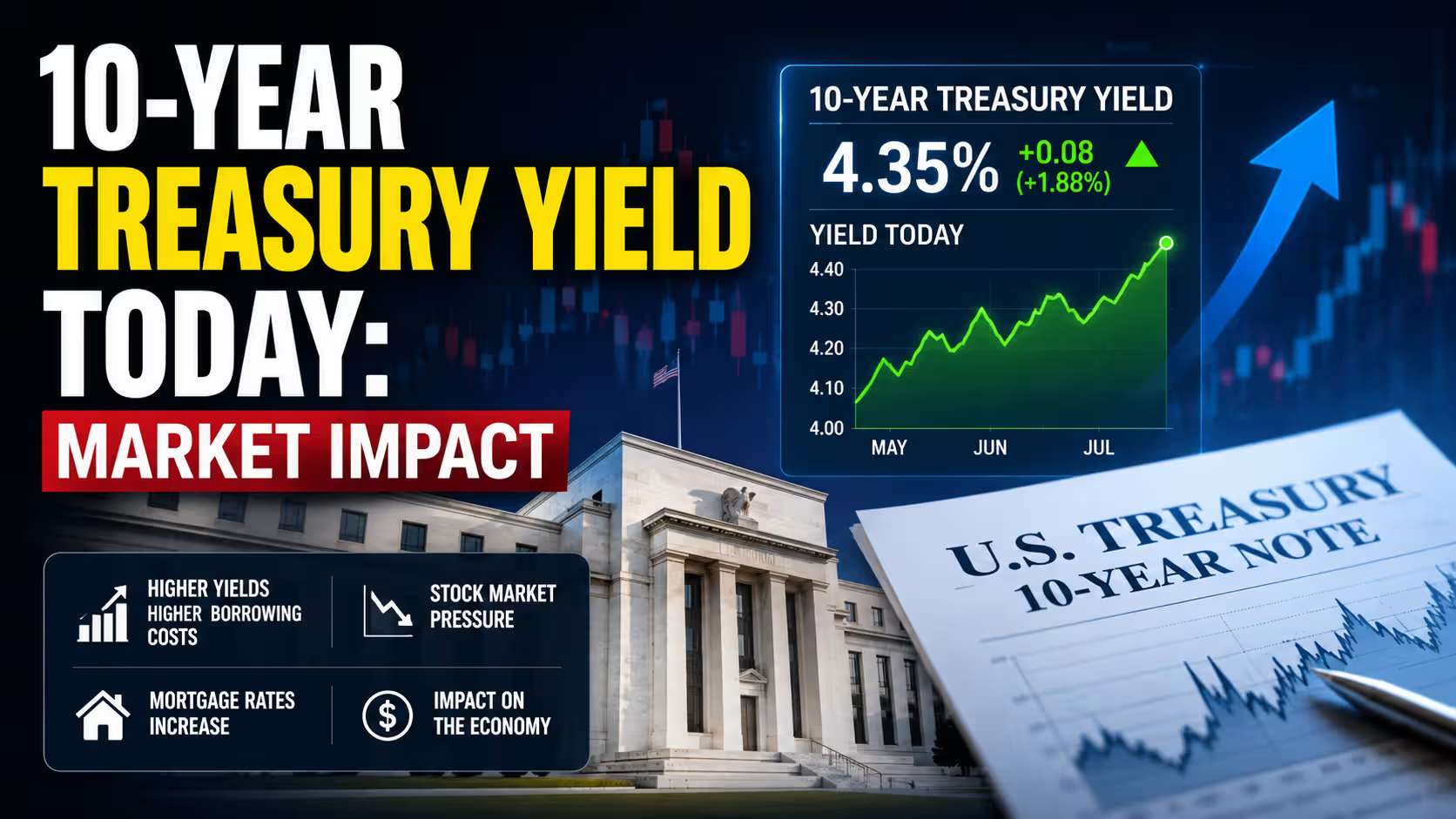
The single biggest catalyst for small-cap stocks has been the Federal Reserve’s shift to cutting interest rates. After years of high rates that crushed smaller, debt-heavy companies, the Fed made three consecutive quarter-point cuts in late 2025.
Why does this matter so much for small caps? The Russell 2000 carries roughly 32% floating-rate debt, compared to just 6% for S&P 500 companies. When rates fall, that debt gets cheaper to service — and suddenly unprofitable companies start looking viable again.
2. Valuations Were at a 25-Year Low
At the end of 2025, the valuation gap between small and large caps had reached its widest point in 25 years. The average price-to-earnings (P/E) multiple for Russell 2000 companies stood at just 19.98x, compared to 28.95x for the S&P 500 and 38.03x for the Nasdaq 100.
That’s a massive discount. Institutional investors noticed. When something is this cheap for this long, a correction eventually comes — and it did.
3. Earnings Are Actually Catching Up
Here’s a fact that often gets overlooked: small-cap earnings are growing fast. Goldman Sachs Asset Management research showed that by late 2025, roughly 25% of Russell 2000 companies were reporting at least two consecutive quarters of accelerating earnings. Analysts now expect small-cap earnings growth of 17% to 22% in 2026 — ahead of projected large-cap results.
That’s not hype. That’s fundamentals improving.
4. Domestic Focus Is Now an Advantage
The Russell 2000 is heavily weighted toward companies that earn most of their revenue inside the United States. In a world where global trade tensions and tariff risks still loom, being domestic-first is actually a competitive edge. As BNP Paribas put it, the “greater customer concentration in the US of small-cap companies should be a benefit to the segment.”
On top of this, the “One Big Beautiful Act” fiscal legislation passed in 2025 stabilized the corporate tax rate at 21% and reintroduced 100% bonus depreciation — a direct win for capital-intensive small firms.
Which Sectors Are Leading the Small-Cap Rally?
Not all parts of the Russell 2000 are moving equally. Here’s where the action is hottest right now:
Regional Banks have led the charge, benefiting from a steepening yield curve and a pickup in middle-market merger and acquisition activity.
Industrials are thriving, with the sector benefiting from domestic investment tailwinds and the reshoring trend that continues to bring manufacturing back to U.S. soil.
Small-Cap Technology has quietly outperformed, with companies tied to AI infrastructure, quantum computing, and the agentic web gaining significant traction within the index.
Healthcare and Consumer Discretionary companies have also provided support, especially as consumer spending remains solid and borrowing costs ease.
The Bull Case: Why This Could Be the Real Breakout
Technical analyst John Roque of 22V Research — who has championed the small-cap trade since the summer of 2025 — now sees the Russell 2000 targeting 3,200, roughly 15% higher from late April 2026 levels. That’s after the index already broke out of a multi-year base around 2,000.
The broader picture supports this. Historically, small caps have outperformed large caps after the Fed starts cutting rates, because they benefit more from lower financing costs. State Street Investment Management points to a “trilogy of tailwinds”: lower interest rates, the end of quantitative tightening, and regulatory support through the Big Beautiful Bill.
The valuation gap also gives small caps room to run. The last time this kind of discount appeared — during the dot-com boom of the late 1990s — small caps went on to outperform for more than a decade.
The Bear Case: Real Risks You Should Not Ignore
This story has risks, and any honest analysis has to cover them.
First, 40% of Russell 2000 companies are still unprofitable. A broader economic slowdown or renewed credit stress could hit these names hard.
Second, there’s a $368 billion small-cap debt maturity wall in 2026. If rates stay elevated — or rise again — refinancing that debt will be painful.
Third, the Fed’s rate-cut path is uncertain. As of May 2026, prediction markets show zero further cuts as the leading outcome, with geopolitical tensions adding to the uncertainty. Rate cuts that don’t come can reverse small-cap momentum quickly.
Finally, while IWM holds broad-based exposure, not all of that exposure is high quality. Selective investors are favoring quality-tilted funds like AVUV and the S&P SmallCap 600 ETF (IJR) over the plain vanilla IWM — precisely because quality matters more when the economic outlook is mixed.
Latest Prediction: Where Could the Russell 2000 Go From Here?
Analyst targets vary, but the consensus leans cautiously bullish. A move toward 3,000–3,200 by year-end 2026 represents the base case for many on Wall Street, assuming rate cuts resume and earnings growth stays on track.
The key level to watch on the downside is 2,300–2,400. Technical analysts warn that a failure to hold that zone could signal a sharper correction. On the upside, a sustained break above 2,800 would likely trigger a new wave of institutional buying.
Bottom Line: Real Breakout or Another Head Fake?
The evidence suggests this rally has more substance than a typical short-term rotation. Lower rates, cheap valuations, rising earnings, domestic-focused revenue, and favorable fiscal policy all point in the same direction. The demand surge in Russell 2000 ETFs reflects genuine conviction from investors who believe small caps have been unfairly overlooked.
That said, it pays to stay selective. The highest-quality small-cap companies — those with real earnings, manageable debt, and strong growth prospects — are where the best risk-reward opportunities live today.
The breakout is real. Whether it becomes a sustained multi-year run depends on whether the Fed delivers, the economy holds, and earnings keep growing. Right now, the odds are better than they’ve been in years.
The Russell 2000 ETF, most commonly represented by the iShares Russell 2000 ETF (IWM), is a fund that tracks the Russell 2000 Index — a benchmark of approximately 2,000 small-cap U.S. companies. It gives investors simple, diversified exposure to the small-cap segment of the U.S. stock market. IWM manages over $65 billion in assets and trades over 25 million shares daily, making it one of the most liquid ETFs available.
Demand for the Russell 2000 ETF has surged due to several key factors: the Federal Reserve cutting interest rates three times in late 2025, a 25-year-wide valuation gap between small and large caps, rising small-cap earnings (projected to grow 17–22% in 2026), domestic-focused revenue streams that shield smaller companies from global trade risk, and favorable fiscal legislation like the 100% bonus depreciation provision that directly benefits capital-intensive small businesses.
Yes, the evidence points to a genuine breakout. Since August 2025, the Russell 2000 has gained roughly 28%, nearly double the S&P 500’s 14% over the same period. The index hit all-time highs in December 2025 and added another 12%+ year-to-date through April 2026. However, risks remain — including a $368 billion debt maturity wall and uncertainty around future rate cuts — so the sustainability of the rally depends on continued earnings growth and Fed policy.
Based on current analyst targets, the Russell 2000 index could reach 3,000–3,200 by end of 2026 if rate cuts resume and earnings growth stays on track. Technical analyst John Roque of 22V Research has a target of 3,200, about 15% higher from late April 2026 levels. The key support level to watch is 2,300–2,400; a break below that zone could signal a deeper correction. These are analyst forecasts, not guarantees, and investing always carries risk.
The main risks include: 40% of Russell 2000 companies are still unprofitable; a $368 billion debt maturity wall in 2026 could stress smaller firms if rates stay high; the Fed’s future rate-cut path is uncertain; and broad index exposure through IWM includes many low-quality names. Investors seeking small-cap exposure may want to consider quality-focused alternatives like AVUV or IJR alongside or instead of IWM.
The Russell 2000 ETF (IWM) tracks 2,000 small-cap companies, while the S&P 500 ETF (SPY) tracks 500 large-cap companies. The Russell 2000 trades at a significant valuation discount — a P/E of roughly 20x versus 29x for the S&P 500. Small caps tend to be more volatile but offer higher growth potential, especially during rate-cutting cycles. They are also more domestically focused, which can be a strength when global trade risks are elevated. For most investors, small caps work best as a complement to — not a replacement for — a large-cap core holding.
Based on current analysis, small caps offer a compelling case: cheap valuations, improving earnings, a supportive rate environment, and strong recent momentum. However, timing the market is always difficult, and the Russell 2000 contains many unprofitable companies that carry real risk. A thoughtful approach is to allocate a portion of your portfolio — many advisors suggest 5–15% — to small-cap exposure rather than making a large all-in bet. Always consider your own risk tolerance and speak with a financial advisor before making any investment decisions.