Nvidia stock (NASDAQ: NVDA) enters the second half of 2026 in an unusual spot for the market’s AI bellwether: up only around 5% year-to-date while chip peers like AMD, Micron, and TSMC have posted double- and even triple-digit gains. Quick answer: shares were trading in the $206–$212 range in mid-July 2026, giving Nvidia a market cap above $5.1 trillion, after pulling back about 18% from a June high before stabilizing on a wave of positive news — eased export controls, a denied product-delay rumor, and a bullish valuation call from Goldman Sachs. Whether NVDA can spark its next bull run depends on a few specific catalysts investors are watching closely.
- Valuation has reset hard: Nvidia’s forward P/E of roughly 21.7x is far below its five-year average near 72x, and close to the S&P 500’s multiple.
- Export policy is a swing factor: eased U.S. controls on UAE sales and newly issued China licenses could reopen major revenue streams.
- The next catalyst is close: Nvidia reports fiscal Q2 2027 earnings in late August 2026, alongside its Blackwell and Vera Rubin platform rollouts.
What Is Nvidia and How Does It Make Money?
Nvidia designs the GPUs and AI accelerator chips that power most of the world’s data centers — it doesn’t manufacture them directly, relying instead on foundry partners like TSMC to actually produce the silicon. Nvidia’s Data Center segment, which sells complete AI infrastructure including compute, networking, and high-speed interconnects, now drives the overwhelming majority of company revenue, with the smaller Graphics/automotive segment rounding out the business. Because Nvidia sits at the center of the AI buildout, its stock is widely treated as a barometer for AI capital spending broadly — which is exactly why 2026’s underperformance has drawn so much attention.
Why Is Everyone Asking If NVDA Stock Can Bounce Back?
The core problem is relative performance. According to The Motley Fool, Nvidia is up about 5% in 2026 even as the broader semiconductor ETF has climbed nearly 59% and rivals like AMD and Micron have gained well over 100%. On top of lagging the group, Nvidia fell about 18% from its June high, including a 10.7% drop in June alone, as the wider “AI trade” cooled — a shift widely tied to reports that OpenAI may delay its IPO to 2027 to protect its roughly $1 trillion valuation, which the market read as a caution signal on stretched AI valuations generally.
More recently, sentiment has turned. Shares jumped over 4% on July 10 after the Trump administration eased export controls on AI chip sales to the UAE, opening a meaningful new market, per TradingKey. Days later, Nvidia denied reports that its next-generation Kyber NVL144 rack-scale AI platform would slip to 2028, and the stock rose more than 1% on the denial, according to TradingKey’s coverage. Licenses for Nvidia’s H20 chip to re-enter China have also started to flow, though a Commerce Department official noted that “very few” H200 chips have actually shipped there so far, per CNBC.
| 2026 YTD Performance | Approx. Return |
|---|---|
| Nvidia (NVDA) | ~+5% |
| PHLX Semiconductor ETF (SOXX) | ~+59% |
| AMD / Micron | +100%+ |
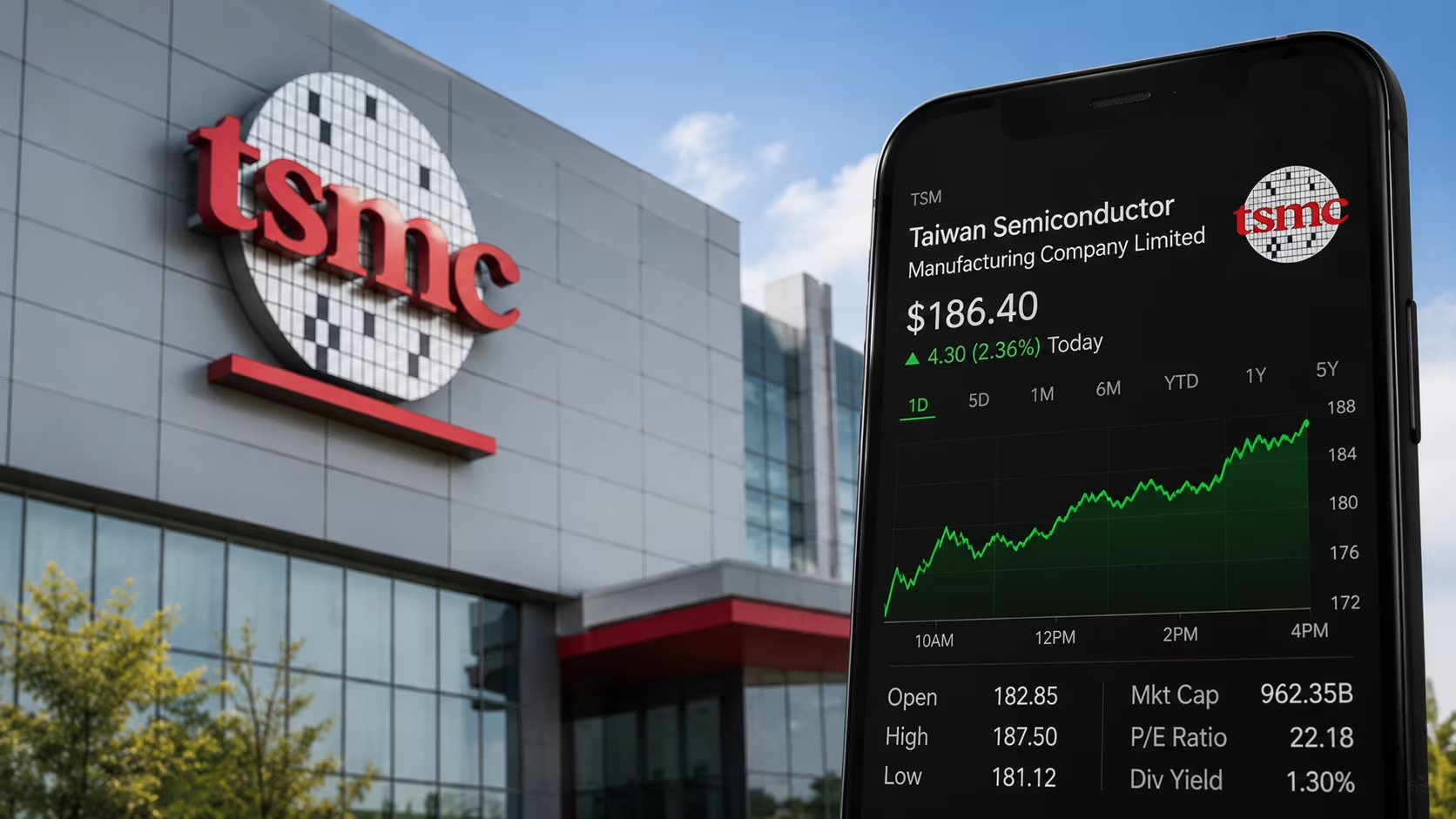
| TSMC (TSM) | ~+35–52% |
Fundamental Analysis and Market Potential
Underneath the stock’s underperformance, Nvidia’s underlying business still looks strong. The company is running a non-GAAP gross margin near 75%, recently returned roughly $20 billion to shareholders through dividends and buybacks, and management authorized an additional $80 billion in share repurchases — a signal of confidence in future cash generation, per FX Leaders. Nvidia also pays a small dividend, though at a 0.13% yield it’s more of a capital-return signal than an income play.
Growth catalysts on the horizon include the ongoing Blackwell ramp, the upcoming Vera Rubin platform, and the Kyber NVL144 rack-scale system Nvidia says remains on schedule. Nvidia also announced a new national AI infrastructure partnership with the Japanese government and industrial leaders this week, extending its footprint beyond U.S. hyperscalers. Notably, TSMC’s own record Q2 2026 earnings — driven largely by AI chip demand — is a useful read-through here, since TSMC manufactures the advanced chips Nvidia designs; strong foundry demand upstream generally points to continued strong Nvidia shipments downstream.
Bank of America maintained a buy rating on Nvidia, calling it a “unique, durable growth franchise” even after the stock’s 2026 underperformance, according to TipRanks coverage.
On valuation, Goldman Sachs has called Nvidia’s forward P/E of 21.7x “compelling” given it sits well below the stock’s five-year average multiple of roughly 72x — effectively pricing Nvidia like an average S&P 500 company despite Wall Street still modeling substantial growth ahead.
Netflix Earnings Report: Key Highlights Investors Can’t Miss
Historical Price Performance
As of mid-July 2026, NVDA traded in a $205.55–$212.50 range, with shares around $206–$212 and a market cap above $5.1 trillion. That’s roughly flat-to-modestly-higher for the year after 2023, 2024, and 2025 delivered market-crushing returns — a sharp change of pace that has fueled the “can Nvidia bounce back” debate. Nvidia’s next earnings report, covering fiscal Q2 2027, is expected in late August 2026.
Key Risks and Volatility Factors
- Cooling AI trade sentiment: reports of OpenAI delaying its IPO have raised broader questions about stretched AI valuations across the sector.
- China policy risk: licenses are flowing again, but actual chip shipments to China remain minimal, and export rules could shift again with little notice.
- In-house chip competition: hyperscalers like Meta are developing custom AI silicon (e.g., its “Iris” chip); the market currently views this as complementary rather than a direct threat, but that view could change.
- Execution risk: Blackwell, Vera Rubin, and Kyber NVL144 all need to ship on schedule to support the growth priced into Nvidia’s stock over the next year.
NVDA Stock Price Chart
For a live, interactive view of NVDA price action, paste this snippet into a WordPress “Custom HTML” block:
Why is Nvidia stock lagging other AI and semiconductor stocks in 2026?
Nvidia is up only about 5% in 2026 versus 59% for the broader semiconductor ETF and 100%+ gains for AMD and Micron, largely due to a cooling in overall AI trade sentiment and an 18% pullback from its June high.
Is Nvidia stock cheap or expensive right now?
Nvidia trades at a forward P/E of about 21.7x, well below its five-year average of roughly 72x and close to the S&P 500’s multiple, which Goldman Sachs has called a compelling valuation relative to Nvidia’s projected growth.
When does Nvidia report its next earnings?
Nvidia is expected to report fiscal second-quarter 2027 earnings in late August 2026.
What could make NVDA stock bounce back in the second half of 2026?
Key catalysts include continued easing of export restrictions, successful on-schedule rollouts of the Blackwell and Vera Rubin platforms, strong fiscal Q2 2027 earnings, and a broader stabilization in AI-sector sentiment.
Is NVDA a good stock to buy in 2026?
Nvidia has strong margins, a reset valuation, and multiple growth catalysts, but also faces China policy risk, cooling AI-sector sentiment, and execution risk on new products. Whether it fits your portfolio depends on your own goals and risk tolerance, so it’s worth consulting a licensed financial advisor before deciding.
Disclaimer: The information provided in this article is for educational and informational purposes only and does not constitute financial, investment, or trading advice. Stocks are highly volatile, and past performance is not indicative of future results. Always do your own research (DYOR) and consult with a licensed financial advisor before making any investment decisions.