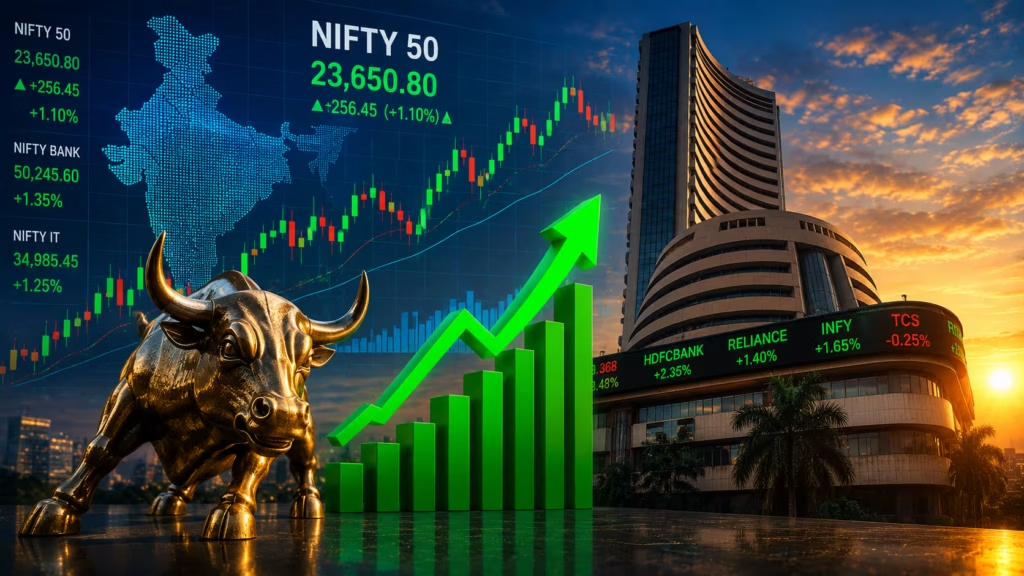
If you are tracking the Nifty 50 share today, here is your complete, up-to-date guide. The Indian market staged a strong comeback on May 14, 2026, with the Nifty 50 climbing 277 points or 1.18% to close at 23,689.60. The BSE Sensex also surged 789.74 points to settle at 75,398.72. This was the second consecutive session of gains after five straight days of selling pressure.
But can this recovery last? Traders and investors are closely watching key resistance levels, global cues, FII flows, and Q4 FY26 earnings results as the market heads into Friday’s session.
Here is everything you need to know — explained simply and clearly.
Nifty 50 Share Today: Where the Market Stands Right Now
The Nifty 50 has had a turbulent few weeks. After hitting its 52-week high of 26,373.20 on January 5, 2026, the index entered a sharp corrective phase. It touched a recent five-session low of 23,379.55 on May 12, 2026.
Thursday’s recovery of 277 points pushed the index back above its five-day moving average — an important technical signal for short-term traders. The daily RSI (Relative Strength Index) is now recovering from an extreme oversold reading of 16.81 that it hit on May 12, and is moving back toward the 35–40 zone.
The India VIX — the market’s fear gauge — declined by more than 4% on May 14. A falling VIX signals that investor nervousness is easing, which is a positive early signal for Friday’s trade.
Key Nifty 50 Levels to Watch on May 15, 2026
Resistance: 23,800 is the immediate resistance zone. A sustained move above this level would signal a potential pullback extension toward 24,100. The broader 23,900–24,000 zone is a stronger supply area where selling pressure is likely to re-emerge.
Support: 23,200–23,000 is the key support band, which coincides with the lower end of the April 8 gap area and the 61.8% Fibonacci retracement of the prior rally from 22,182 to 24,601. A breakdown below 23,000 could open further downside toward 22,900.
According to Bajaj Broking Research, the index needs to consistently form higher highs and higher lows and sustain above 23,800 to confirm a genuine reversal of the current corrective trend.
May 14 Market Summary: What Drove the Rally
Thursday’s recovery was not random. Three clear catalysts drove the market higher.
Trump-Xi Summit in Beijing
The meeting between U.S. President Donald Trump and Chinese President Xi Jinping in Beijing gave global markets a shot of confidence. Traders hoped that the high-level diplomatic engagement would lead to progress on the Strait of Hormuz crisis and ease energy supply concerns. The positive tone from the summit helped lift risk appetite across Asian and emerging markets.
Strong Q4 FY26 Corporate Earnings
Bharti Airtel delivered strong quarterly earnings, with its board also approving a Rs 28,222 crore share swap deal to issue shares to Indian Continent Investment against a swap of up to 59.52 crore shares in the Airtel Africa business. Cipla impressed the market despite reporting weaker-than-expected headline earnings, as its One India business grew a robust 15% year-on-year in Q4 FY26, with all three segments delivering double-digit growth. Its North America business also delivered annual revenue of $780 million.
Nasdaq at an All-Time High
The Nasdaq Composite closing at a record high of 26,402 on the previous session boosted global sentiment and lifted Indian market confidence, particularly in sectors linked to global tech growth.
Top Nifty 50 Gainers and Losers Today
Top Gainers (May 14, 2026)
Adani Enterprises led the charge, surging 8.85% as Adani Group stocks rallied broadly across the board. Cipla was close behind, gaining 8.09% despite the weaker headline numbers, driven by strong business-level performance. Bharti Airtel rose 5.24% after its board-level corporate action. Eternal (formerly Zomato) gained 3.18% and Hindalco Industries added 2.88%.
Top Losers (May 14, 2026)
The IT sector bore the brunt of selling. Infosys fell 2.58%, Tech Mahindra declined 2.33%, HCL Technologies slipped 1.69%, TCS dropped 1.01%, and Coal India shed 1.17%. The weakness in Indian IT stocks came despite the Nasdaq’s record high, as investors focused on company-specific concerns over margins and outlook rather than global index levels.
FII and DII Activity: The Money Flow Story
Institutional money flow is one of the most important drivers of short-term Nifty direction. Here is the latest picture.
Foreign Institutional Investors (FIIs) sold Rs 1,959.39 crore worth of equities on May 12, 2026 — a significant deceleration from the heavy selling of Rs 8,437.56 crore seen on May 11. This sharp reduction in FII selling is itself a positive signal.
Domestic Institutional Investors (DIIs) stepped up strongly, buying Rs 7,990.32 crore worth of stocks on May 12 — the strongest single day of DII buying in May 2026. The Indian market’s domestic support base, driven largely by SIP flows into mutual funds, continues to provide a powerful floor under the market.
On Wednesday (May 13), FIIs sold Rs 1,832.46 crore while DIIs bought Rs 2,446.33 crore, again showing that domestic capital is comfortably absorbing foreign outflows.
After three months of continuous net selling, FIIs turned net buyers in late April 2026. Analysts at NiftyPulse noted that this shift in global allocator sentiment — from “sell into strength” to “selectively add” — suggests India may be entering the early stage of a foreign capital re-allocation cycle.
What Is Hurting the Nifty? Key Headwinds to Watch
Despite the two-day recovery, several serious headwinds remain for the Indian market in May 2026.
Crude Oil Above $100 Per Barrel
This is the single biggest macro risk for India right now. Crude oil prices remain elevated above the $100 per barrel mark — with Brent crude trading around $107 — reflecting ongoing geopolitical tensions and Strait of Hormuz supply disruptions. Since India imports over 80% of its crude oil, high oil prices directly hit the economy through a higher import bill, rupee pressure, rising inflation, and squeezed margins for oil marketing, aviation, and chemical companies.
Weak Rupee
The Indian rupee has been trading near the 95-per-dollar mark, which is under meaningful pressure. A weaker rupee increases import costs and adds to inflationary pressure, while also making Indian assets less attractive to foreign investors in dollar terms.
FII Outflows Still a Risk
While FII selling has slowed significantly, it has not reversed decisively. Continued FII selling at higher levels remains a risk. Analysts warn that if the 3-day rolling average of FII cash flows stays negative through mid-May, last month’s buying may have been short covering rather than genuine re-entry.
Geopolitical Uncertainty
The ongoing West Asia conflict and the evolving Strait of Hormuz situation continue to drive extreme global market volatility. Any negative headline from the region can send crude prices higher and trigger a fresh bout of risk-off sentiment in Indian markets.
Bank Nifty Today: Live Levels and Analysis
Bank Nifty also formed a bullish candlestick pattern on May 14, recovering sharply from oversold territory. But resistance remains a challenge.
Bank Nifty is positioned near the crucial resistance zone of 54,400–54,600. A sustained move above this zone would signal an extension of the pullback toward the 55,000 level.
On the downside, key support for Bank Nifty sits at 52,700–52,400, corresponding to the April 8 gap area and the 61.8% retracement of the earlier rally from 49,955 to 57,456.
Nifty 50 Prediction for May 15, 2026: What Experts Say
Analysts and research firms are broadly constructive on Friday’s opening, with a positive start seen as the base case.
With Nifty, Bank Nifty, and Sensex posting gains of over 1% and India VIX declining more than 4% on Thursday, domestic markets are expected to witness a firm opening supported by improving risk appetite. Strong gains across major European indices could add further momentum, particularly in banking, auto, and metal stocks.
Three key events will decide the direction of trade on May 15:
Tata Steel Q4 FY26 Results: This is the biggest single Nifty 50 earnings event for Friday. The metals sector delivered 53% year-on-year profit growth across the broader market universe in Q4 FY26. A results beat with strong FY27 guidance could add 30 to 50 Nifty points on Friday.
JSW Steel Post-Results Reaction: JSW Steel’s Q4 FY26 results — expected to show revenue of approximately Rs 49,871 crore and profit of Rs 2,669 crore — were announced on May 14. Friday is the first full trading session for the market to react.
IT Sector Bounce Potential: Despite Thursday’s losses, the Nasdaq’s all-time record close raises the prospect of an IT sector recovery. Analysts are watching closely whether HCL Technologies, TCS, Infosys, and Tech Mahindra see buying interest on Friday.
The critical resistance remains at 23,800. A clear close above this level is needed to signal that the pullback has legs and is not just a short-covering bounce.
Nifty 50 Sector Performance: Latest Analysis
Here is how the key sectors are placed as of May 15, 2026.
Pharma and Healthcare: The top-performing sectors in Thursday’s session. The pharma sector remains relatively insulated from the geopolitical turbulence, driven by strong domestic demand and U.S. business growth.
Metals: The second-best performing sector, benefiting from rising commodity prices. Hindalco has been the best-performing Nifty 50 stock over the past year, gaining 73.61%.
IT: Under pressure. TCS is the weakest Nifty 50 component over the trailing twelve months, down 36.21%. The sector faces a dual challenge from high crude prices and global macro uncertainty.
Banking and Financials: Cautious. Bank Nifty is facing resistance at higher levels. PSU banks remain under pressure due to FPI outflows and macroeconomic headwinds.
Energy: Elevated oil prices benefit upstream energy producers but hurt downstream companies like oil marketing companies, airlines, and petrochemical firms.
About the Nifty 50 Index
The Nifty 50 is the benchmark index of the National Stock Exchange of India (NSE). It tracks the top 50 stocks by market capitalization across 13 sectors of the Indian economy. Despite having just 50 companies, the index represents over 60% of the free float market capitalization of all NSE-listed stocks. The list of constituents is reviewed every six months.
The top three companies by market cap in the Nifty 50 today are Reliance Industries, HDFC Bank, and Bharti Airtel — with market capitalizations of Rs 192.17 billion, Rs 120.57 billion, and Rs 113.77 billion respectively.
GIFT Nifty — the successor to the old SGX Nifty — trades on NSE International Exchange in GIFT City, Gujarat, and serves as the most important pre-market indicator for Indian traders each morning.
Bottom Line for Today’s Trader
The Nifty 50 is at a genuine inflection point. The two-day recovery from the May 12 lows is encouraging, but the index still needs to break and hold above the 23,800 resistance zone to confirm that the worst of the selling is over.
Domestic institutional support is strong. FII outflows are decelerating. Earnings season is delivering some positive surprises. Global sentiment has improved on the Trump-Xi summit.
But crude oil above $100, a weak rupee, and ongoing geopolitical uncertainty mean that this remains a news-driven, volatile market where caution is still warranted. Keep position sizes in check, track the 23,800 level closely, and watch crude oil and global developments throughout the day.
The Nifty 50 closed at 23,689.60 on May 14, 2026, gaining 277 points or 1.18%. As of May 15, 2026, markets are expected to open on a positive note, with the key resistance at 23,800 and support in the 23,200–23,000 zone. Traders should track live NSE data for the most current intraday price.
The Nifty 50 reached its 52-week high of 26,373.20 on January 5, 2026. Since then, the index has corrected sharply due to global headwinds including the Strait of Hormuz crisis, elevated crude oil prices, FII outflows, and geopolitical uncertainty linked to the West Asia conflict.
The Nifty 50 has been falling in 2026 due to a combination of factors: elevated crude oil prices above $100 per barrel (a major headwind for India, which imports over 80% of its crude oil), persistent FII selling, a weakening rupee near 95 per dollar, geopolitical uncertainty from the Strait of Hormuz crisis, and global risk-off sentiment. However, strong DII buying and resilient Q4 FY26 earnings have been cushioning the downside.
As of May 15, 2026, the key Nifty 50 resistance levels are 23,800 (immediate) and 24,100 (next target if 23,800 is broken). Key support levels are 23,200–23,000 (strong base) and 22,900 (next downside if support breaks). A sustained move above 23,800 is needed to confirm a genuine recovery, while a breakdown below 23,000 could accelerate selling.
On May 14, 2026, the top Nifty 50 gainers were Adani Enterprises (+8.85%), Cipla (+8.09%), Bharti Airtel (+5.24%), Eternal (+3.18%), and Hindalco Industries (+2.88%). The top losers were Infosys (-2.58%), Tech Mahindra (-2.33%), HCL Technologies (-1.69%), Coal India (-1.17%), and TCS (-1.01%). The IT sector continues to face headwinds while pharma and metals are leading the recovery.
On May 12, 2026, FIIs (Foreign Institutional Investors) were net sellers of Rs 1,959.39 crore — a sharp slowdown from Rs 8,437.56 crore of selling on May 11. DIIs (Domestic Institutional Investors) bought Rs 7,990.32 crore, the strongest DII buying day of May 2026. This strong DII support is acting as the primary floor for the market, even as FII outflows continue.
For the short term, analysts say the Nifty 50 needs to break and hold above 23,800 to signal an extension of the pullback toward 24,100. If it fails to do so, a correction back toward the 23,400–23,000 support zone is likely. Key variables to watch include the outcome of Tata Steel’s Q4 results, the direction of crude oil prices, FII flow data, and any diplomatic developments from the Strait of Hormuz situation. A decisive reclaim above 24,000 is needed to restore medium-term bullish confidence.