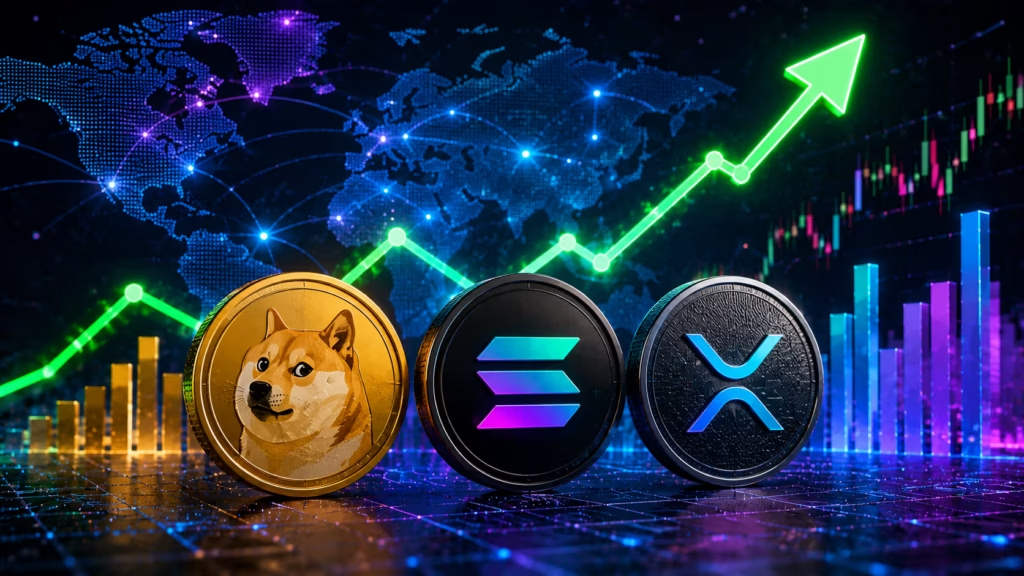
If you’ve been watching crypto prices in 2026, you’ve probably noticed something interesting. When Dogecoin goes up, Solana and XRP usually go up too. When one drops, the others often follow. Dogecoin, Solana, and XRP all move together more often than not — and understanding why this happens could help you make smarter decisions with your money today.
This is not a coincidence. It’s a pattern rooted in how the crypto market actually works. Let’s break it all down in plain English.
What Does “Crypto Correlation” Mean?
Correlation simply means that two or more assets tend to move in the same direction at the same time.
In crypto, a high correlation between coins like DOGE, SOL, and XRP means that when market sentiment turns bullish, they all tend to rise together. When fear takes over, they fall together.
This is different from stocks, where individual companies can rise or fall based on their own earnings or news. In crypto, the whole market often moves as one big wave — especially altcoins.
How Correlated Are These Three Coins Right Now?
The data from May 2026 tells a clear story. As of early May 2026, ETH was up +3.90%, DOGE was up +4.75%, SOL was up +2.48%, and XRP was up +2.34% — all moving in the same direction on the same day, backed by live data from Binance and OKX.
That’s correlation in action, playing out in real time.
Why Do Dogecoin, Solana, and XRP All Move Together?
There are several key reasons behind this pattern. None of them are mysterious — once you understand them, the market becomes a lot less confusing.
1. Bitcoin Sets the Tone for Every Altcoin
Bitcoin is the leader of the crypto market. When Bitcoin moves, everything else tends to follow.
Right now in 2026, Bitcoin dominance sits at around 58.5–60%. That means nearly 60 cents of every dollar in crypto belongs to Bitcoin. When Bitcoin rises, investors feel confident and start putting money into altcoins like DOGE, SOL, and XRP. When Bitcoin falls, that confidence dries up fast.
This is why altcoins rarely move in the opposite direction of Bitcoin for long. They’re all riding the same wave.
2. Institutional Investors Treat Crypto as One Risk Asset
This is a big one. In 2026, large institutions — hedge funds, asset managers, and corporations — are deeply involved in crypto. And they don’t treat DOGE, SOL, or XRP as separate investments. They treat the entire crypto market as a single “risk asset” category.
When they feel good about risk, they buy crypto broadly. When they don’t, they sell it all at once. This behavior pushes all coins in the same direction at the same time.
As one market analysis put it, crypto is now part of a larger “risk asset ecosystem,” meaning it behaves more like a sector than a collection of independent currencies.
3. Macro Conditions Hit All Coins the Same Way
In 2026, macro factors like U.S. Federal Reserve policy, inflation data, and the strength of the dollar drive crypto just as much as any blockchain news.
When financial conditions tighten — say, interest rates go up — investors pull money out of risky assets, including crypto. All altcoins feel it. When conditions ease, money flows back in and everything lifts together.
The crypto bull run tracker for May 2026 shows the broader market has a strong correlation with the S&P 500 at 84% and gold at 87%. These aren’t independent markets anymore — they’re connected to global money flows.
4. Retail Sentiment Follows Headlines
Retail investors — everyday people buying crypto — tend to react to the same news cycle. A positive regulatory headline, a new ETF approval, or a tweet from an influential figure can push DOGE, SOL, and XRP all upward at the same time, simply because people feel excited about crypto as a whole.
This sentiment-driven behavior creates short bursts of strong correlation, especially among high-profile coins.
What’s Driving Each Coin in 2026 — Beyond the Correlation
While DOGE, SOL, and XRP often move together, each coin has its own story right now. Understanding the differences gives you an edge.
Dogecoin (DOGE): Still Sentiment-Driven
Dogecoin started as a joke in 2013 but has grown into a legitimate digital asset with a market cap of around $17 billion, making up more than half of the entire meme coin sector.
DOGE remains highly sentiment-driven. Its price action is strongly influenced by community enthusiasm and social media activity. Tesla accepts DOGE for select merchandise purchases, and platforms like PayPal and Revolut support Dogecoin transactions — giving it real-world utility that keeps interest alive.
The risk with DOGE is that it has no hard price floor. When sentiment turns negative, it can drop fast.
Solana (SOL): Performance Backed by Real Usage
Solana is the strongest performer in this group on a year-to-date basis in 2026, up around 180% YTD. And unlike DOGE, its price strength tracks real on-chain activity.
Solana handles fast, cheap transactions and supports a growing DeFi ecosystem. Daily transaction volumes remain elevated, driven by decentralized exchange activity, stablecoin movement, and app usage. Its total value locked (TVL) has grown substantially, and new institutional ETF inflows have added to the momentum.
One recent analysis described Solana as “absorbing real flow, not short-lived speculation” — which is a meaningful distinction in today’s market.
XRP: Regulatory Clarity Changes Everything
XRP has been one of the biggest stories in crypto over the past year. After Ripple’s decisive legal win against the U.S. Securities and Exchange Commission, the regulatory cloud that had suppressed XRP’s price for years was removed.
As of 2026, XRP is up over 400% year-to-date, making it the top performer among large-cap altcoins. Institutional investors are flowing into XRP through newly approved ETFs. XRP ETF inflows have exceeded $1.3 billion, supporting a strong accumulation trend.
XRP’s core strength is its role in cross-border payments. The XRP Ledger settles transactions quickly and cheaply, which is why financial institutions use it for remittances and global settlement.
What This Crypto Correlation Tells You as an Investor
Understanding that DOGE, SOL, and XRP often move together is useful — but it’s what you do with that knowledge that matters.
Don’t Assume Diversification Within Altcoins
Many people think buying three different altcoins means they’re diversified. But if DOGE, SOL, and XRP all move together, you’re taking on similar risk across all three positions.
True diversification in crypto means spreading across different asset types — not just different altcoin names.
Use Bitcoin Dominance as Your Compass
Watch Bitcoin dominance closely. When BTC dominance falls below 57%, it has historically signaled that capital is rotating into altcoins more broadly. When it stays above 59–60%, altcoin gains tend to be selective rather than widespread.
Right now, BTC dominance is hovering around 58.5–60%. That means not all altcoins are winning — only those with strong fundamentals or institutional backing are leading.
Know the Difference Between Correlation and Cause
Just because DOGE, SOL, and XRP move together doesn’t mean one causes the other to move. They’re all responding to the same external forces — Bitcoin’s price, macro conditions, and market sentiment.
This means that if you’re bullish on all three, you’re really making one big bet on positive market sentiment. That’s fine — just be aware of it.
Latest Analysis: Selective Altcoin Season, Not a Broad Rally
One of the most important insights from 2026 market data is this: altcoin season is not happening uniformly. The Altcoin Season Index has not broadly triggered, meaning most altcoins are not outperforming Bitcoin.
Instead, capital is flowing selectively into coins with real institutional demand — specifically XRP, Solana, and Ethereum. DOGE benefits when sentiment is strong, but it’s not driven by institutional capital the same way.
Dogecoin, Solana, and XRP All Move Together — Is That a Problem?
Not necessarily. But it does require you to think differently about your portfolio.
High correlation between altcoins is normal during Bitcoin-led bull markets. The key is understanding what phase the market is in. Right now in 2026, the market is in a selective rotation phase — not a full altcoin explosion. Investors who pick coins with strong fundamentals and institutional backing are doing better than those who scatter capital across everything.
The good news? All three coins — DOGE, SOL, and XRP — have genuine narratives behind them in 2026. The risks are different for each, but so are the upside stories.
Quick Summary: What to Remember
Dogecoin, Solana, and XRP move together largely because of shared macro conditions, Bitcoin’s market leadership, institutional behavior, and retail sentiment. This correlation is strongest during broad market moves and weakens when individual fundamentals take over.
In 2026, the smart approach is to understand why the correlation exists, monitor Bitcoin dominance, and separate sentiment-driven assets like DOGE from fundamentals-driven ones like SOL and XRP.
FAQ
They move together mainly because of Bitcoin’s influence on the overall market, shared macro conditions like interest rates and liquidity, and the behavior of institutional investors who treat all altcoins as a single risk asset category. When confidence in the crypto market rises, capital flows into all three at once.
Not necessarily. High correlation means your altcoins tend to rise and fall at the same time, so you don’t get the diversification benefit you might expect. The key is to be aware of it and avoid treating different altcoins as truly independent bets when they share the same market drivers.
Bitcoin dominance measures Bitcoin’s share of the total crypto market cap. In mid-2026, it sits around 58.5–60%. When dominance is this high, capital tends to stay in Bitcoin and only rotate selectively into top altcoins like XRP and Solana. A drop below 57% would signal a broader altcoin rally.
XRP has been the strongest year-to-date performer in 2026, up over 400% YTD, driven by regulatory clarity after Ripple’s legal win against the SEC and strong institutional ETF inflows exceeding $1.3 billion. Solana is up around 180% YTD, backed by real on-chain activity and institutional interest. Dogecoin lags both but benefits from sentiment-driven retail momentum.
Not in the traditional broad sense. The Altcoin Season Index has not fully triggered in 2026. Instead, the market is seeing selective rotation — capital is flowing into specific coins with institutional backing like XRP, Solana, and Ethereum, rather than a rising tide that lifts all altcoins equally.
Dogecoin’s price is largely driven by community sentiment, social media activity, and broader market enthusiasm. It also benefits from real-world adoption — Tesla accepts DOGE for merchandise, and PayPal and Revolut support DOGE transactions. However, it lacks a hard price floor, which makes it more volatile than XRP or Solana during market downturns.
Watch Bitcoin’s price and Bitcoin dominance first. If BTC dominance starts falling below 57–58%, it often signals capital rotating into altcoins. Also watch macro indicators like Fed interest rate decisions and U.S. inflation data, as these directly influence investor risk appetite. ETF inflow data for XRP and Solana is also a reliable leading signal in 2026.