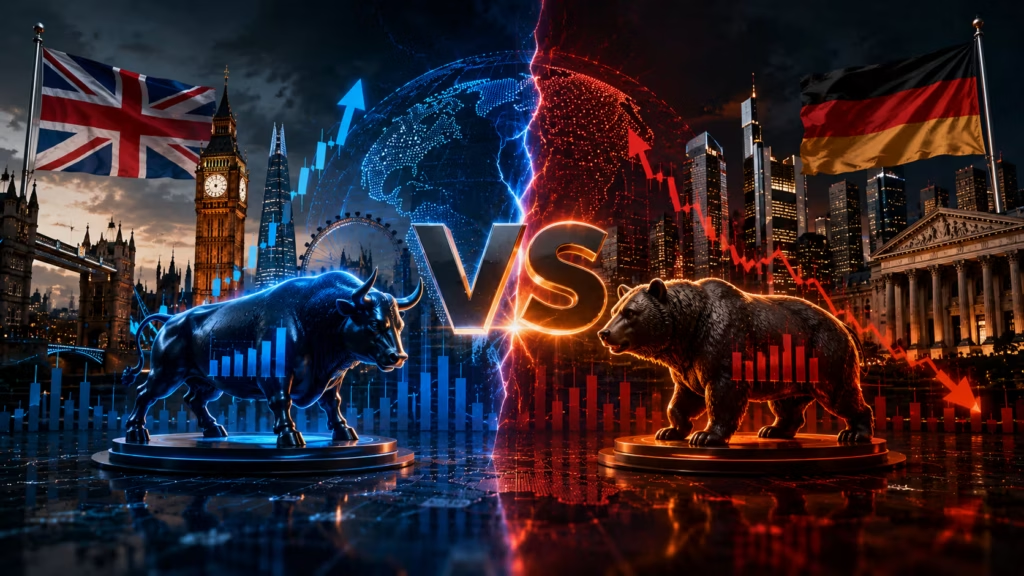
FTSE 100 vs DAX: Which European Index Wins in a Volatile Global Market? That question is getting sharper by the week in 2026. Both indices hit historic highs at the start of the year. Then the Iran war erupted, oil prices surged past $100 a barrel, inflation fears returned, and markets across the world shook hard. Today, the FTSE 100 trades near 10,300 points while the DAX navigates a world of tariffs, energy costs, and resurgent German defense spending. In this latest analysis, we break down how each index works, how they behaved under pressure, and which one looks better positioned for what comes next.
FTSE 100 vs DAX: Which European Index Wins in a Volatile Global Market?
Before we compare them head to head, it helps to understand what each index actually is — and how they differ at a structural level.
What Is the FTSE 100?
The FTSE 100 — often called the “Footsie” — tracks the 100 largest companies listed on the London Stock Exchange (LSE) by market capitalisation. It launched in January 1984 with a base value of 1,000 points.
On January 2, 2026, the FTSE 100 broke through 10,000 points for the first time in its 42-year history. That followed a remarkable 2025 in which the index climbed 21.6% — its best annual performance since 2009.
The FTSE 100 is a price index. That means it tracks share prices but does not automatically include dividends in its headline return figure. This is an important detail we return to later when comparing it directly to the DAX.
Sector-wise, the FTSE 100 skews toward what analysts call “old economy” heavyweights. Financial services, energy, pharmaceuticals, mining, and consumer goods dominate the index. Shell, AstraZeneca, HSBC, BP, Unilever, and Rio Tinto are among its largest constituents.
Crucially, roughly 75% of FTSE 100 revenues come from outside the UK. This makes it more of a global index wearing a British badge than a pure reflection of the UK domestic economy.
What Is the DAX?
The DAX (Deutscher Aktienindex) is Germany’s premier stock market benchmark, operated by Deutsche Börse on the Frankfurt Stock Exchange. In September 2021, it expanded from 30 to 40 constituents and is now officially called the DAX 40.
As of January 2026, the combined market capitalisation of DAX 40 companies exceeded €1.8 trillion. The index surpassed the milestone of 25,000 points for the first time at the start of 2026, extending a bullish run that began in the second half of 2022.
The DAX is significantly different from the FTSE 100 in one key structural way: it is a total return index. That means it includes dividends reinvested, not just share price movements. This makes direct performance comparisons with the FTSE 100 — a price index — somewhat misleading. The DAX’s headline gains are naturally higher because of this methodology.
The sector makeup of the DAX reflects Germany’s industrial economy. As of early 2026, industrials account for 24% of the index, technology 18%, financials 16%, and healthcare 13%. SAP, Siemens, Rheinmetall, Allianz, Deutsche Bank, BASF, BMW, and Volkswagen are among its major names.
How Each Index Performed in 2025 and Early 2026
2025: A Stellar Year for Both
Both indices delivered exceptional returns in 2025.
The FTSE 100 surged 21.5%, outpacing all three of Wall Street’s major averages for the first time in many years. Investors returned to UK equities in force, drawn by attractive valuations, high dividend yields, and the index’s heavy weighting in energy, mining, and defence — all sectors that performed strongly.
The DAX rose over 20% in 2025 as well. Standout performers included Rheinmetall, which rose approximately 150% on booming European defence budgets, and Siemens Energy, up roughly 140% as AI-driven energy infrastructure demand surged.
Both indices entered 2026 in strong form, hitting all-time highs in the first week of January.
2026: The Iran War Changes Everything
On February 28, 2026, the U.S. and Israel launched joint military strikes against Iran. Within days, the Strait of Hormuz — through which roughly 20% of the world’s oil flows — faced a near-standstill of commercial traffic. Brent crude surged from around $70 to above $100 a barrel.
Markets across Europe fell sharply. But the two indices behaved differently.
When Iran-related tensions escalated in early April 2026, DAX futures fell 1.9% versus FTSE 100 futures down just 0.9%, according to Invezz data. In other words, the DAX was hit harder in the acute phase of the shock.
The FTSE 100 hit its all-time high of 10,934 on February 27 — the day before the strikes began — and then fell hard. By late March, it had dropped below 10,000 points, losing 10% or more from its peak and entering technical correction territory. Richard Hunter, head of markets at Interactive Investor, noted that “any strength in the oil majors has been insufficient to offset losses elsewhere.”
However, the picture shifted as the war dragged on. On March 23, 2026, the DAX rose 1.3% while the FTSE 100 ended nearly flat, as CNBC reported, with UK banking stocks — NatWest, Lloyds, Barclays — leading FTSE losses.
As of May 19, 2026, the FTSE 100 is trading near 10,299-10,350 points, still up roughly 3-5% year-to-date but well below its February peak.
FTSE 100: Strengths and Weaknesses in Today’s Market
The Case for the FTSE 100
The FTSE 100 offers several clear strengths in a volatile world.
First, it is an income machine. Total cash returned to investors via dividends and buybacks reached approximately £180 billion in 2025. Analysts already forecast around £130 billion — or 4.6% of total market cap — returned to shareholders in 2026 alone. That cash yield exceeds the Bank of England base rate and UK inflation, making it compelling for income investors.
Second, the index still trades at a significant discount to U.S. and most European indices. Despite hitting 10,000, valuations remain attractive on a price-to-earnings basis. As Jemma Slingo of Fidelity International put it in January 2026, “the FTSE 100 still trades at a discount to the US and Europe, even as sentiment towards UK companies improves.”
Third, the FTSE 100’s heavy weighting in oil and gas benefits directly when energy prices rise. Shell and BP each gained nearly 3% on a single day in early April as oil surged to $110 a barrel.
The Risks Facing the FTSE 100
The UK is a net energy importer, sourcing around 40% of its fuel from overseas. That makes the domestic economy — and eventually consumer spending — acutely vulnerable to sustained oil price shocks.
UK inflation jumped to 3.3% in March 2026 after the Iran war. KPMG cut its UK GDP growth forecast for 2026 to just 0.7%, down from 1.3% in 2025. Higher inflation means the Bank of England faces pressure to keep rates elevated, which weighs on growth stocks and rate-sensitive sectors like banking and real estate.
The FTSE 100 also carries structural weaknesses that have persisted for years. It has shallow pools of local capital compared to U.S. markets, few quoted technology firms, high listing costs, and an ongoing exodus of companies frustrated with lacklustre stock price momentum.
DAX: Strengths and Weaknesses in Today’s Market
The Case for the DAX
Germany’s fiscal revolution is the DAX’s biggest tailwind right now.
The German government approved a landmark €500 billion special investment programme — known as the Sondervermögen — to modernise the economy through spending on infrastructure, digital networks, defence, and energy. Chancellor Friedrich Merz also secured Bundestag approval to exempt defence spending from Germany’s constitutional “debt brake,” unlocking a structural shift in public investment.
The scale of German defence spending is historic. According to SIPRI data published in April 2026, Germany achieved a 24% year-on-year increase in defence spending, reaching $114 billion — the largest single-year percentage increase among major NATO powers and the first time since 1990 that Germany spent more than 2% of GDP on defence.
This directly benefits DAX defence names. Rheinmetall, which rose 150% in 2025, continues to attract strong institutional interest. CMC Markets forecasts that MDAX earnings — the mid-cap German index — could rise by roughly 30% in 2026 as government infrastructure funds begin flowing into the real economy.
DZ BANK targets the DAX at 27,500 by end-2026, citing fiscal stimulus, controlled inflation, and strong earnings in industrials, tech, and finance. The FAZ survey consensus from 29 institutions averaged 25,979 for the DAX in 2026.
The Risks Facing the DAX
Germany’s economy and its flagship index face genuine headwinds.
Tariffs are a major threat. European automakers tumbled in early May 2026 when President Trump threatened to raise tariffs on EU cars and trucks to 25%. Mercedes-Benz shed 3.4%, Volkswagen lost more than 2%, and Continental fell 4.6% in a single session. Volkswagen had already reported a 53% year-on-year drop in operating profit for 2025, partly attributing it to Trump’s tariff regime.
Valuations look stretched. The DAX trades on a price-to-earnings ratio of around 21, well above its historical average of approximately 15. Higher bond yields have pushed up borrowing costs for the capital-intensive sectors that dominate the index — carmakers, utilities, and chemicals.
German energy costs are also rising sharply. As an energy-intensive manufacturing economy, Germany feels oil price spikes through wider cost channels than the UK. The Iran-driven energy crisis adds margin pressure across industrials and chemicals throughout the DAX.
DAX vs FTSE 100: The Total Return Trap
One of the most important facts that everyday investors miss when comparing these two indices is the total return difference.
The DAX is a total return index. Its headline number includes dividends reinvested. The FTSE 100 is a price index. Its headline number does not.
If you adjusted the FTSE 100 to include reinvested dividends — creating a “total return FTSE 100” — its performance over the past five and ten years would look considerably stronger than the standard number suggests. FTSE 100 companies pay some of the most generous dividends in the developed world.
This means that simply comparing DAX points gained to FTSE 100 points gained is an apples-to-oranges exercise. Over the long run, the dividend-adjusted return gap between the two is smaller than raw index comparisons suggest.
Which Index Is Better for Investors Today? A Practical Analysis
There is no single answer. It depends on what an investor is trying to do.
If You Want Income and Stability
The FTSE 100 wins. Its dividend yield, broad sector diversification across genuine global multinationals, attractive valuations relative to U.S. peers, and commodity-heavy mix make it compelling for income investors and those seeking portfolio resilience.
If You Want Growth and Cyclical Exposure
The DAX has an edge. Germany’s fiscal stimulus, defence spending surge, and global industrial and technology exposure position the DAX for strong earnings growth — provided tariff risks and energy cost pressures remain manageable. For investors willing to accept higher volatility, the DAX’s upside potential through 2026 is arguably greater.
If You Want to Hedge Against Geopolitical Risk
This one is genuinely interesting. When the Iran war broke out, the FTSE 100 was initially more resilient — its oil and gas majors provided a natural hedge as energy prices spiked. But the DAX recovered faster on individual sessions as ceasefire signals emerged, because its growth-oriented nature means it responds more sharply to positive news.
For Long-Term Portfolio Builders
Both indices serve a purpose. Many professional investors blend them to balance cyclical growth (DAX) with income and defensive resilience (FTSE 100). UBS noted in March 2026 that commodities and defence stocks deserve a place in portfolios regardless of index preference, and that “making snap decisions to de-risk amid geopolitical conflict has historically not been a profitable strategy.”
Latest Prediction: Where Do FTSE 100 and DAX Go From Here?
FTSE 100 Outlook
The FTSE 100 remains anchored in a globally diversified mix of high-yield, commodity-exposed companies. Analysts at Ninety One called UK indices a “striking” breadth of opportunity in April 2026, highlighting HALO sectors — energy, mining, utilities, and industrials — as more resilient to disruption. The index’s path back to its all-time high near 10,934 depends largely on whether UK inflation eases and whether the Iran conflict approaches resolution. A return above 10,500 would signal a recovery of investor confidence.
DAX Outlook
The DAX consensus forecast from major German and European banks averages around 25,979 by end-2026, with DZ BANK targeting as high as 27,500. The German government’s infrastructure and defence spending programmes are multi-year tailwinds, and SAP’s continued dominance in enterprise software provides technology-driven earnings growth. The key near-term risks are tariff escalation and prolonged energy cost pressures. A resolution of the Strait of Hormuz crisis would likely trigger a sharp DAX recovery given its exposure to manufacturing and export-led sectors.
The biggest structural difference is how each index is calculated. The DAX 40 is a total return index, which means it includes dividends reinvested in its headline number. The FTSE 100 is a price index and does not include dividends in its main figure. This makes direct performance comparisons misleading. Sector-wise, the FTSE 100 is dominated by energy, financials, mining, and pharmaceuticals, while the DAX is heavily weighted toward industrials, technology, and automotive companies. The FTSE 100 has 100 members; the DAX has 40.
Both delivered strong returns in 2025. The FTSE 100 climbed approximately 21.6%, its best annual performance since 2009, and outpaced all three major Wall Street indices for the first time in years. The DAX rose over 20% in the same period. Standout DAX performers included Rheinmetall, up around 150% on European defence spending, and Siemens Energy, up approximately 140%. On a total return basis, the DAX’s gains would appear higher due to its dividend-reinvestment methodology, but the price performance of both indices was comparable.
Both indices fell sharply after the U.S.-Israel military operation against Iran began on February 28, 2026. The FTSE 100 dropped from its all-time high of 10,934 to below 10,000 — a correction of more than 10%. The DAX fell harder in the immediate shock, with DAX futures dropping 1.9% compared to FTSE 100 futures down 0.9% during key escalation moments. The FTSE 100 initially showed more resilience due to its oil and gas heavyweights (Shell, BP), but UK inflation and energy import dependence weighed on it over time. Both indices have partially recovered as ceasefire negotiations progressed.
The FTSE 100 offers attractive income prospects in 2026. Analysts project dividends and buybacks of around £130 billion — approximately 4.6% of total market cap — for the year, a yield that beats the Bank of England base rate and inflation. Valuations remain at a discount to U.S. and many European peers. However, risks include rising UK inflation (3.3% in March 2026), weaker GDP growth forecasts (0.7% for 2026 per KPMG), and the UK’s vulnerability to energy price shocks as a net energy importer. It suits income-focused investors more than pure growth seekers.
Major German and European banks hold cautiously optimistic targets for the DAX in 2026. DZ BANK targets 27,500 points by year-end, citing fiscal stimulus, controlled inflation, and strong industrials and technology earnings. Deutsche Bank forecasts a consolidation near 25,000 points. A consensus survey of 29 institutions published by FAZ averages a target of approximately 25,979 for end-2026. Key upside drivers include Germany’s €500 billion Sondervermögen spending programme and continued defence budget growth. Key risks are U.S. tariffs on EU goods and prolonged energy price pressure from the Iran conflict.
The two indices have very different sector exposures, which drives different behaviour in crises. The FTSE 100 has a high weighting in oil and gas companies — like Shell and BP — which benefit directly when energy prices spike during geopolitical shocks. The DAX, by contrast, is heavily weighted toward energy-intensive manufacturers like automakers and chemical companies, which face higher costs when oil rises. This means the FTSE 100 tends to hold up better in the immediate energy-shock phase, while the DAX can recover more sharply when tensions ease, because its growth-oriented composition responds faster to positive news flow.
It depends on your investment goals. The FTSE 100 suits income-focused investors who want high dividend yields, defensive sector exposure, and relatively modest valuations. The DAX suits growth-oriented investors who are comfortable with higher volatility and want exposure to Germany’s industrial renaissance, defence spending boom, and technology sector. Many professional portfolio managers blend both indices to balance income with growth and to diversify across different risk factors. Neither index is universally better — the right choice depends on your time horizon, risk tolerance, and whether you prioritise income or capital growth.